Mountain grade is the deciding factor on every Haywood County job
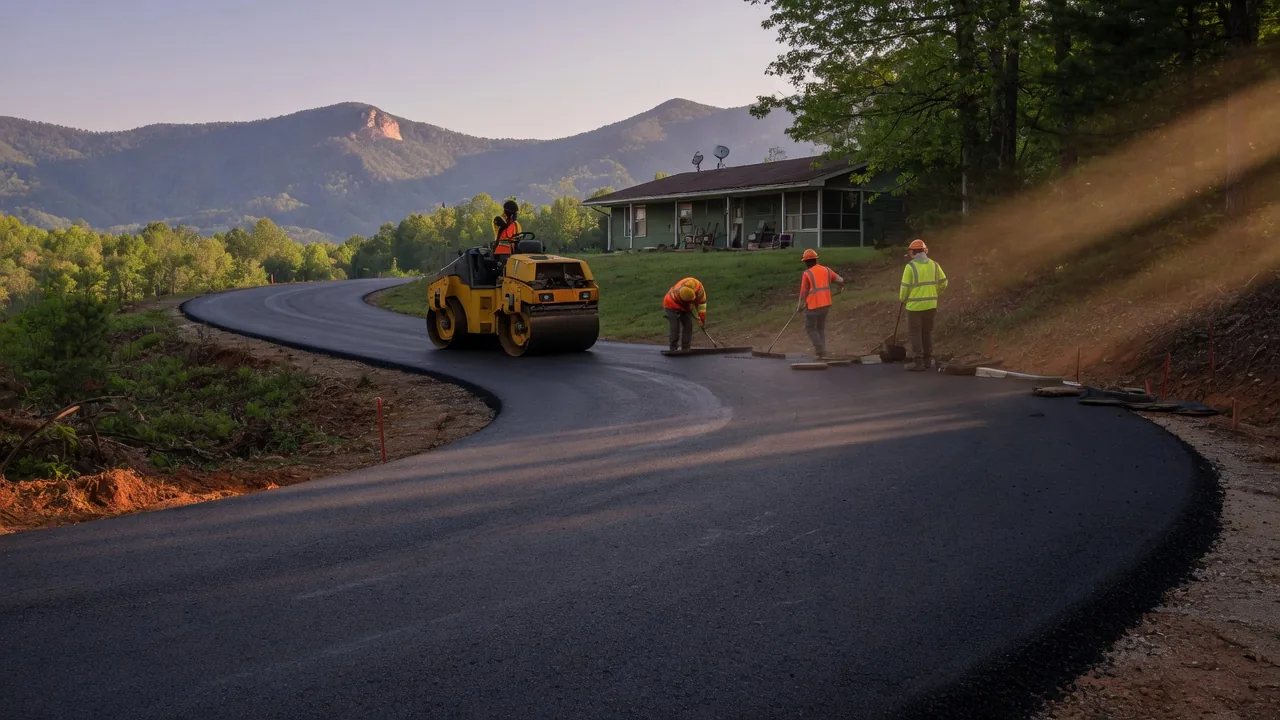
Waynesville sits in a mountain cove at roughly 2,600 feet, and the driveways here reflect the terrain: steep pulls up wooded ridges, long runs through hollow lots, switchbacks on hillside parcels that wouldn't exist at lower elevation. Grade is the first variable that separates a quote in this county from one priced on a flatland job, and it changes both the oil application rate and the base preparation requirements. A steep run needs a compacted base engineered for drainage and for resisting downhill creep under repeated wheel load. Any contractor who quotes per square foot before walking your slope is pricing the average, not your driveway.
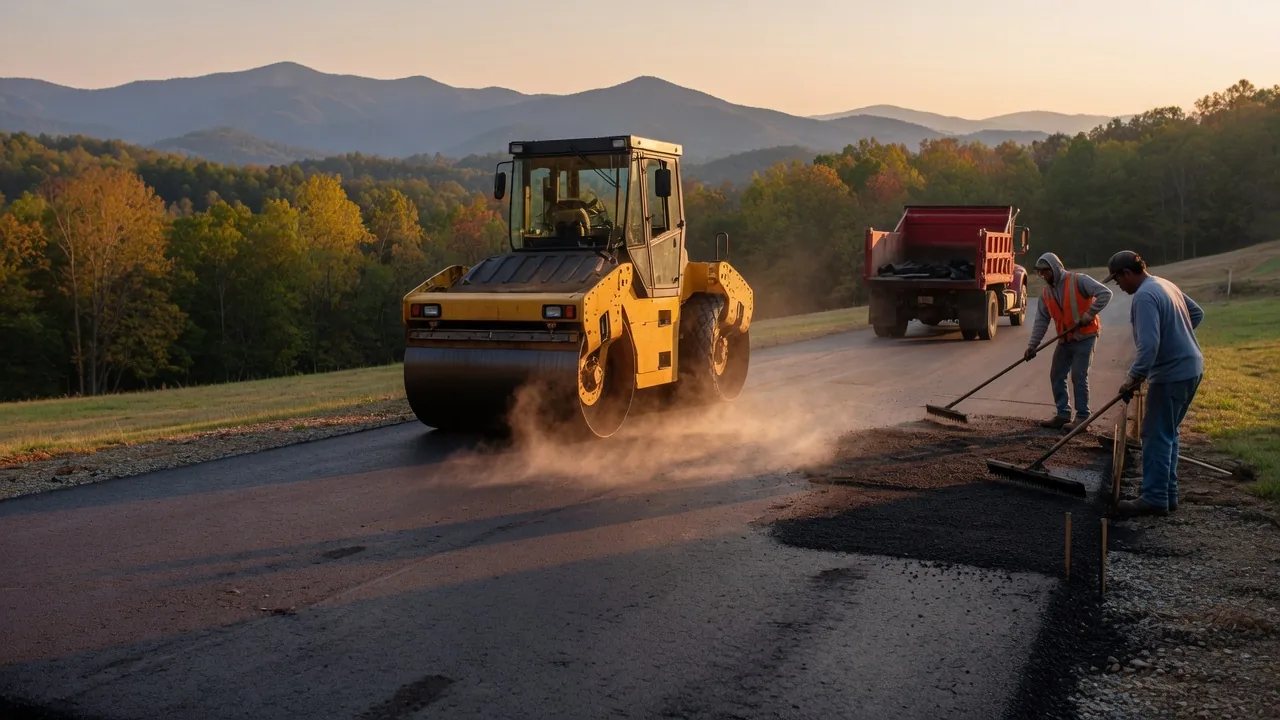
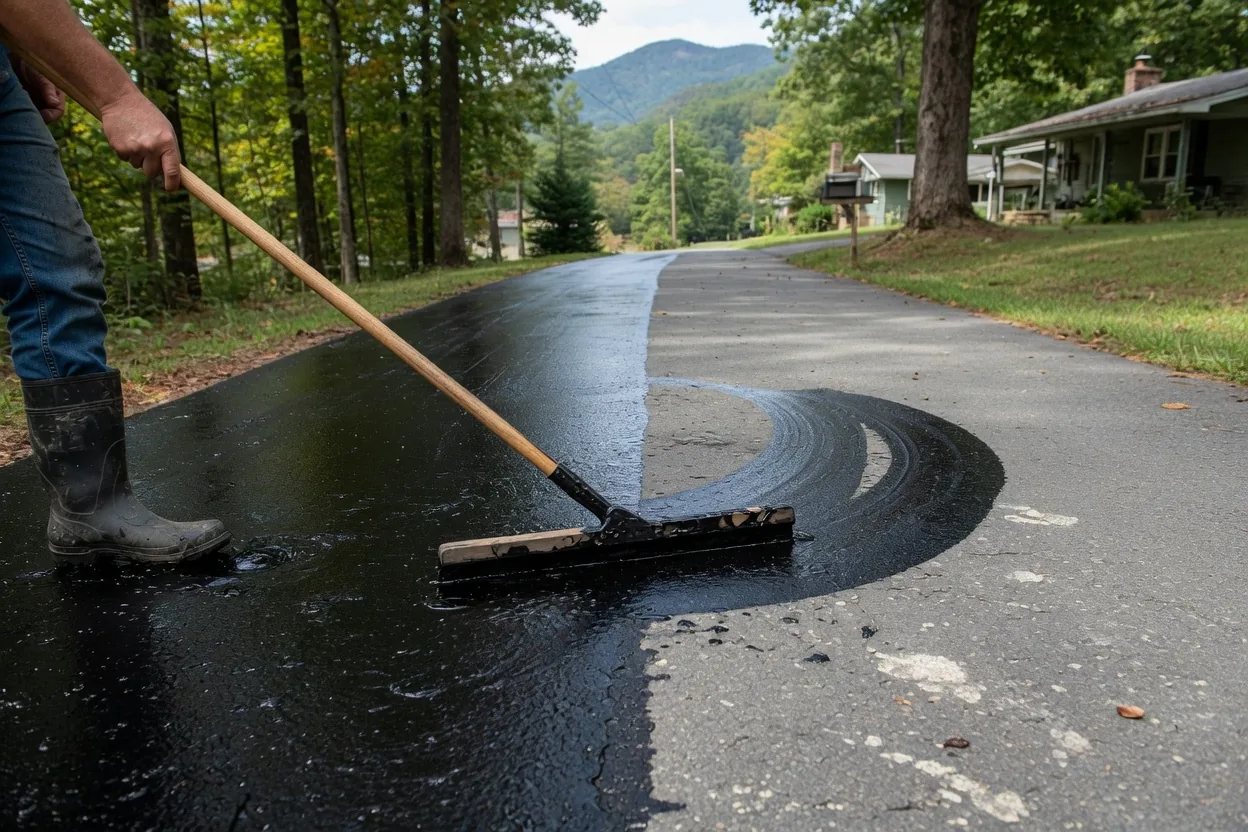
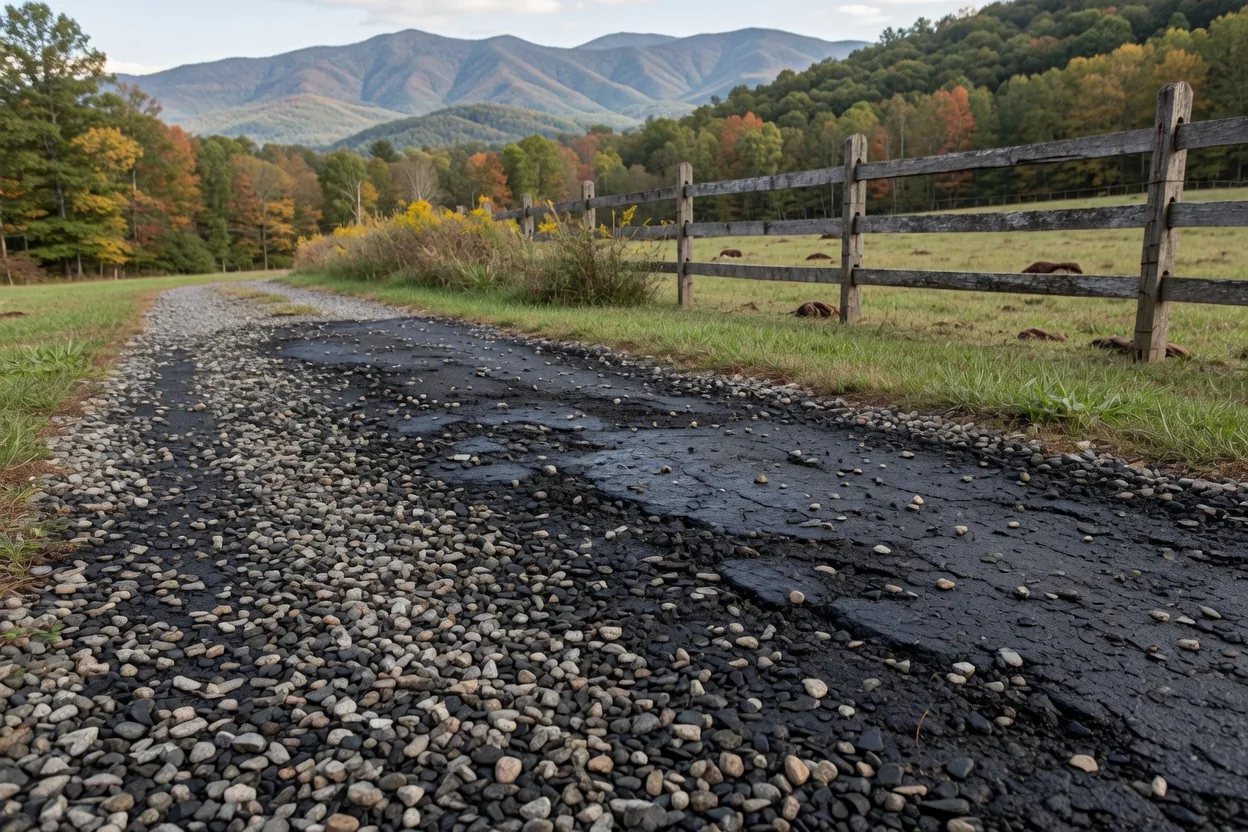
The practical reason tar and chip — also called chip seal — is common in Haywood County isn't purely cosmetic. The crushed aggregate embedded in the binder creates a textured surface that grips on wet grades where smooth blacktop becomes slick, especially through the mountain autumn when leaf fall keeps surfaces damp for days at a stretch. At Waynesville's elevation, freeze-thaw cycling through winter puts more mechanical stress on a surface than a piedmont job faces; the stone-in-binder structure handles that movement differently than a continuous asphalt layer. For the older farmsteads, wooded residential lots, and rural properties that define this county, the surface also reads as part of the surrounding landscape in a way that polished blacktop rarely does.
Scope and price ranges for Waynesville driveways
Tar and chip driveways around Waynesville run $3.50 to $6.50 per sq ft installed, putting a 1,000 sq ft driveway in the $3,500 to $6,500 range. Grade, base condition, and coat count are the primary variables. The table below maps common scope types to typical price ranges for Haywood County installations.
| Scope | Typical Range |
|---|---|
| Single coat on prepared base, flat to mild grade (per 1,000 sq ft) | $3,500–$4,500 |
| Single coat on prepared base, steep grade (per 1,000 sq ft) | $4,500–$5,800 |
| Double coat application — high traffic or long-term durability (per 1,000 sq ft) | $5,500–$6,500 |
| Gravel-to-chip-seal conversion including grading and base prep (per 1,000 sq ft) | $4,200–$6,500 |
| Edge repair and drainage correction | Quoted by linear foot |
Base condition is the variable most bids leave vague. A driveway with a stable, well-graded gravel base needs less prep than one with ruts, soft spots, or improper drainage. Ask for base preparation as a separate line item rather than folded into a composite square-foot rate. The full breakdown of what drives cost on these jobs is at tar and chip driveway cost.
What mountain weather asks of a driveway surface
Haywood County carries 19 federal disaster declarations on record spanning 1973-2026, the majority tied to storm and flood events in a mountain watershed that collects rainfall from across the Southern Appalachians. The National Weather Service consistently places this region among the highest annual precipitation zones in the eastern US. Every surface installed here goes through repeated saturation cycles, freeze-thaw stress at elevation, and seasonal movement that coastal or piedmont jobs simply don't face at the same frequency.
For chip seal specifically, drainage grade at installation matters more than product specification. Water that pools at a low point, collects at an edge, or backs up against a foundation will undermine the base layer faster than any surface wear. Before the first pass of oil, a competent contractor's attention belongs on where the water moves after a heavy rain, not on how the finished aggregate will look. The NC Department of Transportation designs its own chip seal road surfaces around drainage as a primary criterion — the same standard applies to residential work in this terrain.
NCDOT permits when your driveway meets a state road
A large share of rural Haywood County driveways connect directly to NCDOT-maintained secondary roads — the numbered state routes that trace the county's hollows, creek corridors, and farm valleys. If your driveway access point touches one of those roads, a driveway permit is required before any new paving or reconstruction work begins. Applications go through NCDOT Connect, NCDOT's online permit portal. Requirements cover sight distance from the access point, apron construction standards, and drainage management at the road connection — details a paving contractor working near any state right-of-way should handle without prompting.
If your driveway connects only to a private road or runs entirely within your property, no NCDOT permit is required. For new access construction from scratch, confirm whether Haywood County's planning department has additional requirements, particularly on lots within a recorded subdivision with its own road maintenance agreement. That check takes a phone call and prevents a stop-work situation after base grading has already started.
Converting a gravel driveway to chip seal
Many properties in Haywood County run on established gravel driveways that are functional but rough, dusty in summer dry spells, and soft through the wet months. Chip seal over a stable gravel base is a practical upgrade: it seals the surface, controls dust, and improves traction without the material and labor cost of a full asphalt build-up. The comparison at gravel to asphalt covers when chip seal is the right step and when a full base replacement is the honest answer before anything gets sealed.
The conversion works when the existing base is compacted, correctly crowned, and draining to the right side. A base that ruts in wet weather, holds standing water, or shows soft spots in the lane needs grading and aggregate work before the seal coat goes down. That prep is the cost variable that most surprises homeowners on conversion jobs. A contractor who walks the base before quoting is the one worth hiring. More on what the installation process involves is at tar and chip driveways.
Hiring well in a mountain-terrain market
Three questions sort the field quickly. First: has the crew paved on grades similar to yours? Chip seal on a steep mountain lot requires different binder temperature management and aggregate spread control than a flat suburban job. Ask for references that match your terrain, not just your county. Second: how do they handle edge drainage? The uphill and downhill edges of a chip seal surface on a Haywood County lot are where water damage starts first; a contractor who explains edge grading without prompting has worked this terrain before. Third: what does the base inspection tell them before they price the job?
The site walk is where the real estimate happens on a mountain driveway. A number given over the phone is an average. Waynesville driveways vary enough in grade, base quality, and drainage challenge that the walk-through determines whether the job sits at the low end or the high end of the band. When you're ready to schedule and want to know exactly what a first visit should include, the process is covered at tar and chip driveways.