Buncombe County terrain shapes every thickness decision
Asheville sits at roughly 2,100 feet in the southern Blue Ridge, and most residential lots in Buncombe County sit on residual clay — the weathered product of metamorphic rock that expands when saturated and contracts during dry spells. That shrink-swell behavior, compounded by freeze-thaw cycles that arrive at elevation from October through late March, puts more stress on a thin-base driveway than vehicles alone would on flatter terrain in the Piedmont. A 2-inch surface over a 4-inch base that holds up adequately in coastal NC can show edge cracking and rutting in Buncombe County within a few winters if the subgrade is clay-heavy or the site drains poorly.
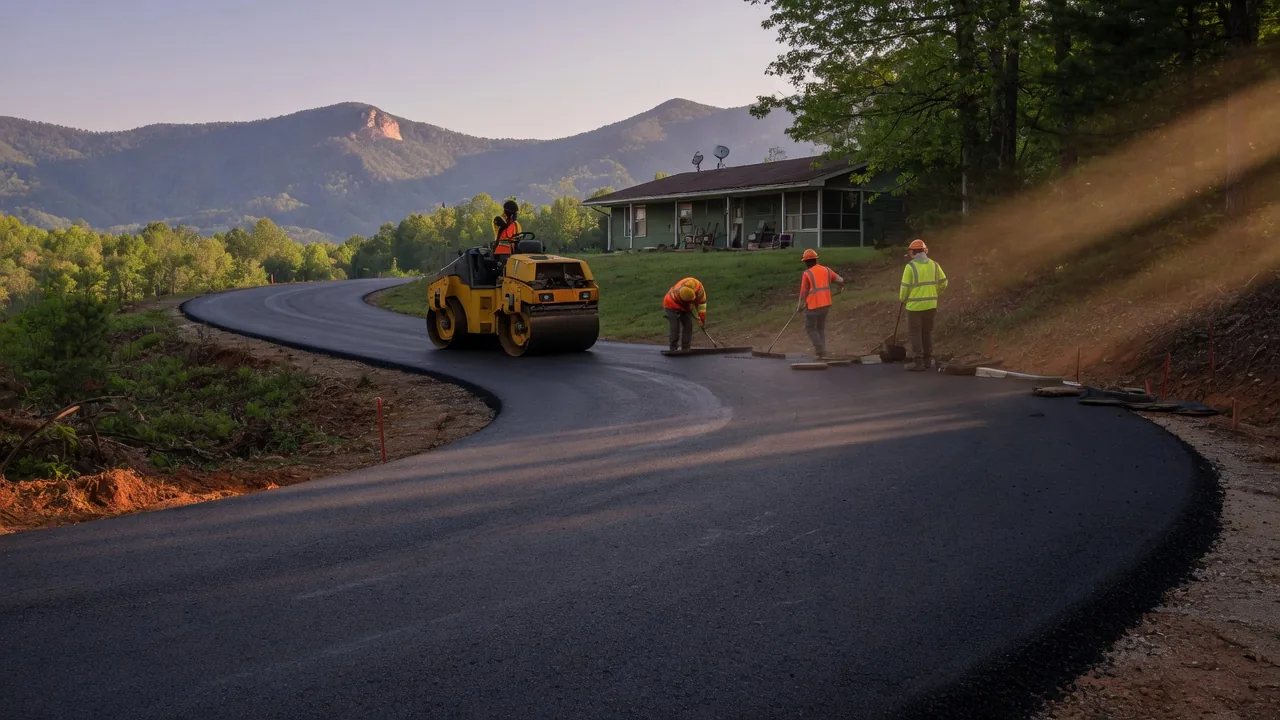
The county's topography adds another layer: a significant share of residential driveways here slope meaningfully, and some slope steeply. A steep-grade driveway adds drainage and surface-course tie-in demands that a flat approach never does. Decisions that work fine at level grade become inadequate combined with a 12-percent climb in West Asheville or on a rural lot off a county road in the western part of the county.
Before any question about surface thickness gets answered, the base course is the governing variable — and understanding what that base needs starts with knowing what is under it and how steeply it runs. The table below maps the standard spec ranges; the sections that follow cover the permit and right-of-way requirements that apply before the first ton of material moves.
Thickness by use and load: the working matrix
The ranges below reflect industry practice and guidance from the NC Department of Transportation for flexible pavement in this climate zone. All figures assume proper subgrade preparation — which in Buncombe County means removing or stabilizing any organic material, soft clay, or fill before aggregate goes down. A thick surface over a poorly prepared subgrade still fails.
| Use and load type | Surface course | Aggregate base | Notes |
|---|---|---|---|
| Standard residential (passenger cars only) | 2 in. compacted | 4 in. compacted | Minimum; suitable only on stable, non-clay subgrade |
| Residential with occasional heavy vehicles (delivery trucks, RVs) | 2.5–3 in. compacted | 6 in. compacted | Recommended spec for most Buncombe County conditions |
| Steep grade (over 8% slope) | 2.5–3 in. compacted | 6–8 in. compacted | Drainage and surface tie-in details critical; see steep driveway guide |
| NCDOT road connection (apron) | Per NCDOT specification | Per NCDOT specification | Permit required via NCDOT Connect before paving |
| Shared or commercial-adjacent driveway | 3 in. minimum | 6–8 in. | Verify with county or city inspections before bidding |
For how base depth and total square footage translate to project price, the asphalt driveway cost guide breaks down where the money goes — and why two bids for the same driveway can differ by thousands.
NCDOT driveway permits: when state-road access requires approval
The majority of roads in unincorporated Buncombe County — including rural routes, US and NC state highways, and secondary roads outside Asheville's city limits — are maintained by the North Carolina Department of Transportation. Any driveway that ties into an NCDOT-maintained road requires a permit through NCDOT Connect before construction begins.
NCDOT's driveway permit process covers far more than pavement thickness. It specifies apron width, drainage, sight-distance requirements, and the geometric tie-in detail where the driveway meets the road shoulder. If a driveway is paved without a permit on an NCDOT road, the department can require removal and full reconstruction at the owner's expense — the permit is the controlling document, and work that deviates from its specifications has no administrative standing.
Permit applications, required drawings, and the fee schedule are all handled through NCDOT Connect. Contractors who work this area regularly manage the application as part of the job. If you are replacing an existing driveway that already has an approved NCDOT connection, confirm whether the existing permit still applies — changes in apron width or drainage geometry often trigger a fresh review, not a simple transfer. Processing time varies by the workload in NCDOT's Division office serving this area; building the permit timeline into the project schedule prevents the kind of delay that leaves a half-finished job sitting through a rainy week.
City of Asheville right-of-way: what changes inside city limits
Within Asheville's jurisdiction, any driveway work that crosses a public sidewalk or curb requires a right-of-way encroachment permit from the City of Asheville — separate from any NCDOT permit and separate from any building permit the county inspections department might require. The city specifies material, cross-slope, and transition details at the street edge, and city staff inspect the completed apron before the encroachment permit closes.
This matters most in Asheville's older residential neighborhoods — Montford, West Asheville, Kenilworth, and others — where curb cuts often predate current standards. A full driveway replacement that touches the apron commonly triggers a curb cut review, and an existing cut that does not meet current city standards may need to be rebuilt as part of the project. That is not optional; it is a condition of the encroachment permit.
Buncombe County has recorded 19 federally declared disasters over 1973-2026, nearly all driven by stormwater and flooding. The city's scrutiny of driveway drainage at the permit stage reflects that documented pattern. A driveway graded without adequate cross-slope that sends runoff toward a neighbor's property or overwhelms a street drain will draw questions during review. Getting drainage right in the design is faster and cheaper than revising it after the right-of-way inspector visits.
What an under-spec driveway costs after the crew leaves
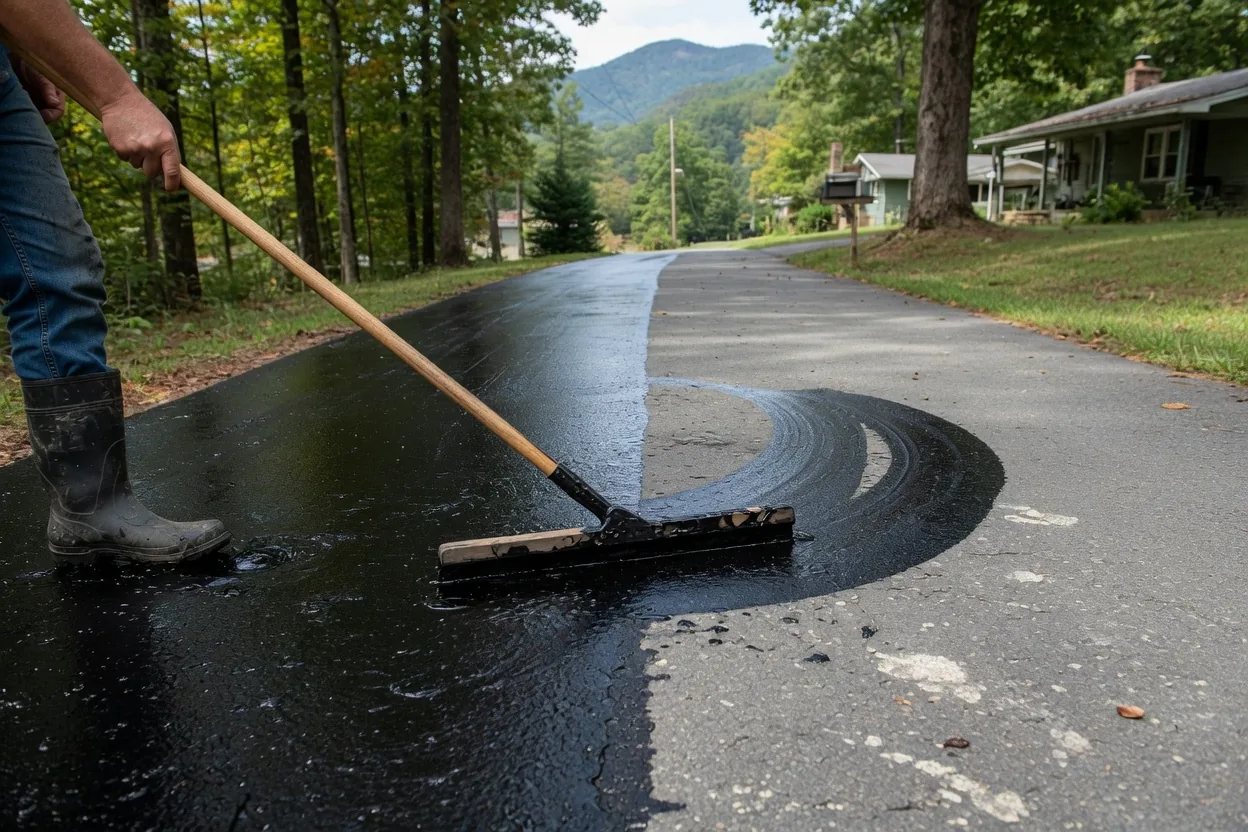
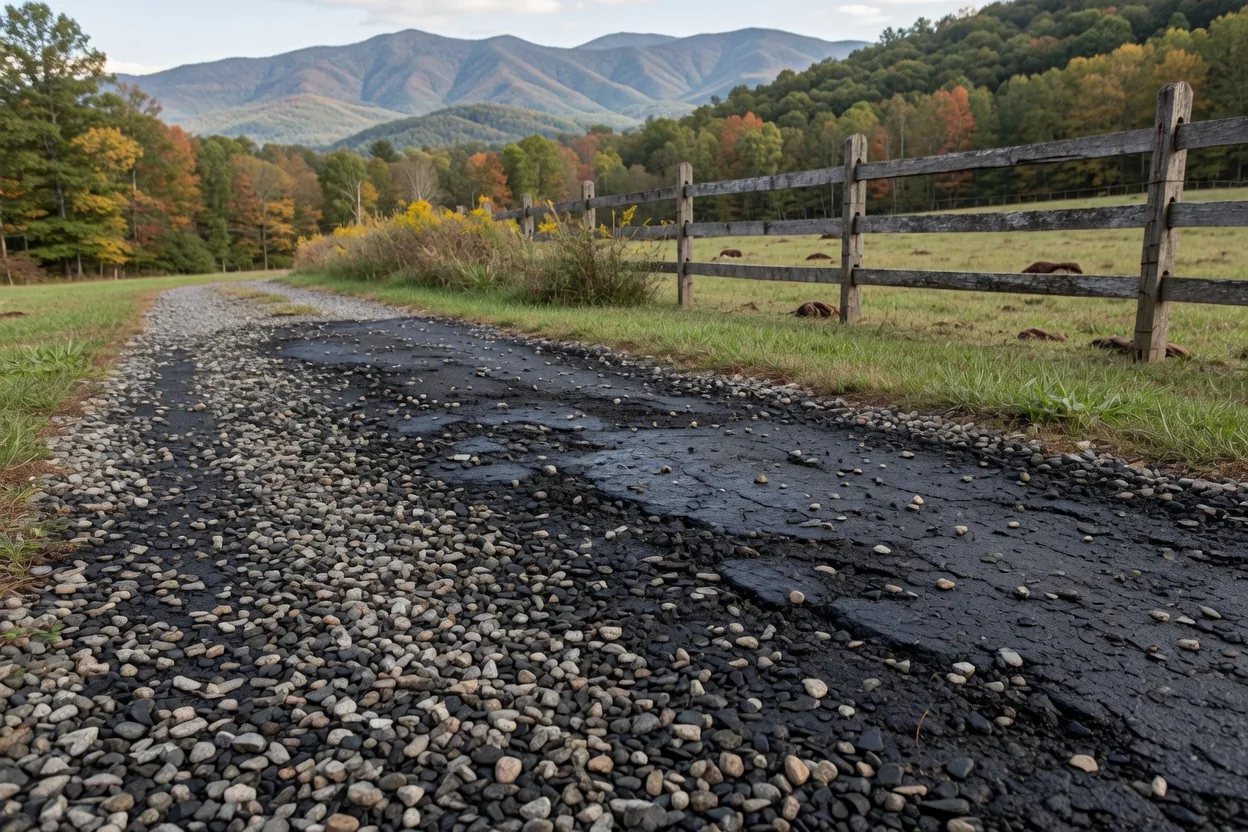
The failure pattern for under-built driveways in Western NC follows a predictable arc: the surface looks sound through the first summer, develops edge cracking in year two or three as the base shifts under freeze-thaw and clay movement, and demands repair or full replacement within five to eight years. The aggregate base is structural; the asphalt surface is protective. When the base is undersized, the surface fails from underneath regardless of how thick it is — no amount of seal-coating covers a base that has shifted.
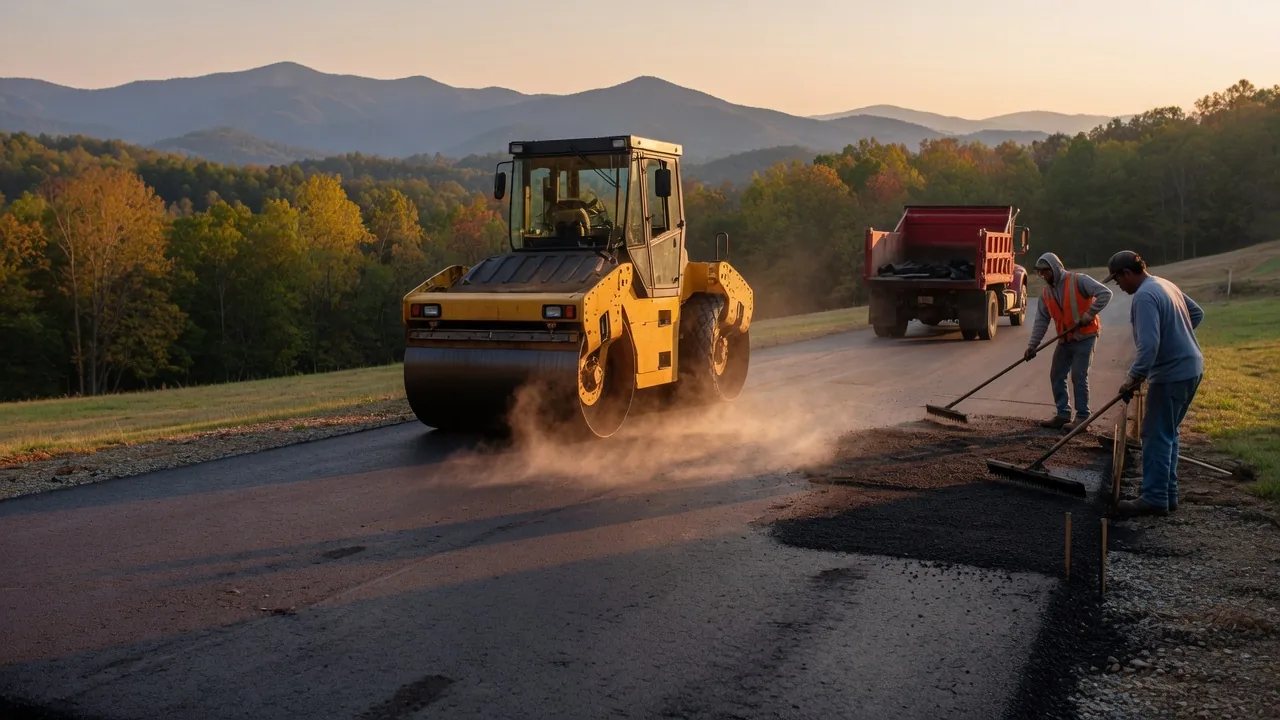
A properly spec'd driveway — 2.5 to 3 inches of hot-mix asphalt on 6 inches of compacted aggregate over a prepared subgrade — costs more upfront. The cost guide shows how that additional base depth affects the total project price; the difference between a minimum-spec and a right-spec job is a fraction of what an early replacement runs. The NCDOT pavement design standards governing state road construction reflect decades of performance data in exactly this climate — those numbers did not emerge from caution; they emerged from roads that failed when built to less.
Pressing your contractor on three specific questions separates a durable driveway from a cheap one: what surface-course thickness are they installing in compacted lifts, what aggregate depth are they placing before the mat goes down, and is the subgrade being proof-rolled before any stone moves. For driveways that climb, the steep driveway guide adds spec considerations specific to grade. Get the answers in writing before you sign.