Cut-and-fill lots change what's underneath
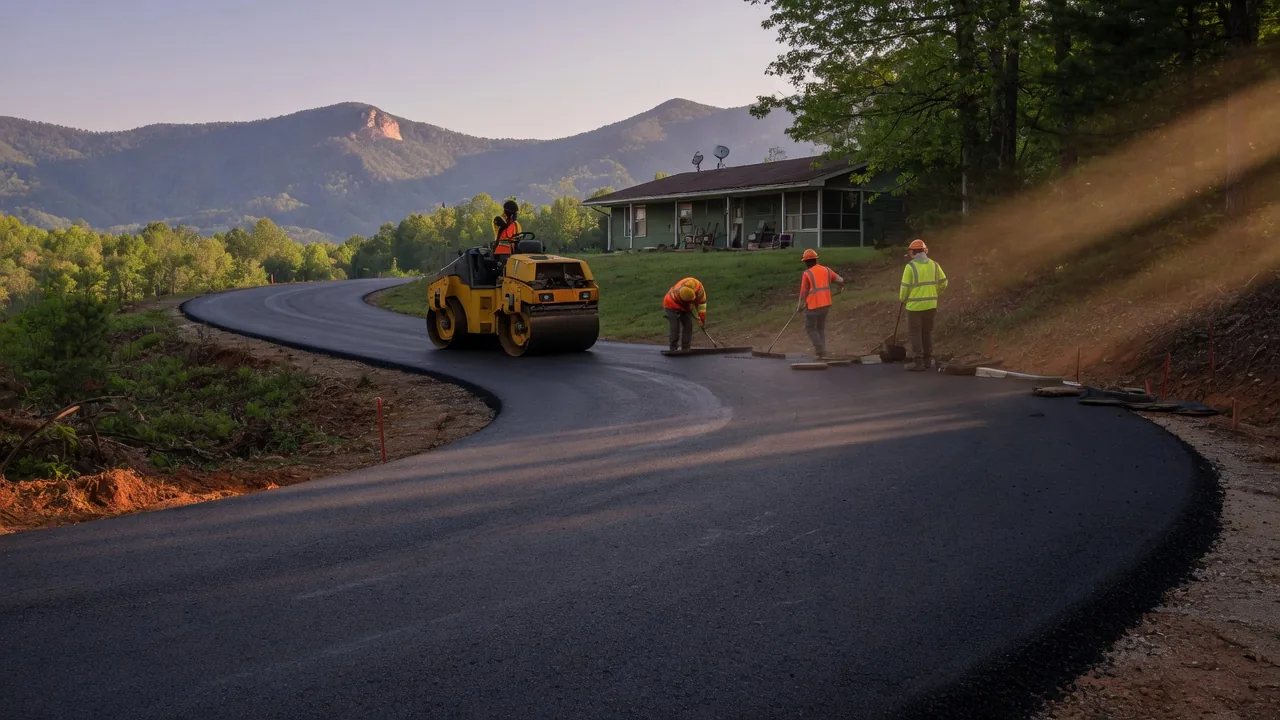
Buncombe County home sites are often carved from ridge slopes — cut on the uphill side, fill material placed on the downhill side, and a driveway running across both in the same 60-foot run. That construction pattern means the pavement rests on two very different ground conditions in the same slab: undisturbed native soil on the upper half and compacted fill below. The fill side settles first and settles longest, which is why driveways above Swannanoa, along the ridgelines near Leicester, and on steeper streets off Merrimon Avenue develop that characteristic low corner rather than a centered bowl. New construction on the hillsides above Weaverville and Woodfin is adding to this pattern — cut-and-fill driveways on lots that haven't fully consolidated are a growing repair category, not just an aging-housing-stock problem.
Appalachian clay soils add another layer. Mountain residual clay expands when saturated and contracts in dry summers, working against any compacted base through each seasonal swing. Buncombe County's residential elevations — most neighborhoods sit between 2,000 and 3,500 feet — also bring freeze-thaw cycling that accelerates base damage faster than piedmont driveways in the lowlands ever experience. Ridge-lot driveways frequently become the drainage path of least resistance for uphill runoff, so a sinking driveway that looks like a pavement problem is almost always a soil-and-water problem one layer below.
Four failure patterns and what each one signals
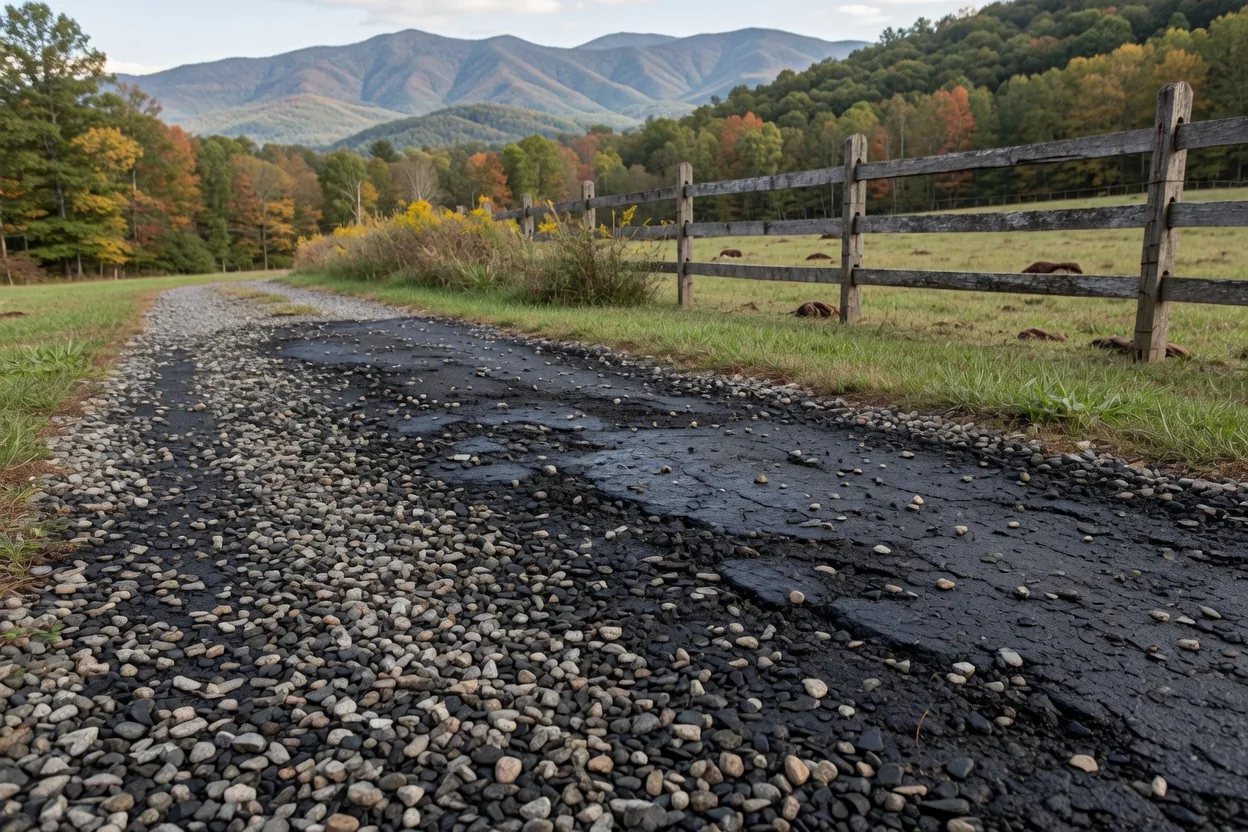
The shape of the sinking carries information. An edge depression angling toward the low side of the lot usually means drainage has been washing base material downhill for seasons — slow, cumulative, and invisible until the surface follows. A mid-run dip on a longer driveway crossing a hillside grade points to fill consolidation: the original compaction held temporarily, but long-term settlement caught up. Alligator cracking paired with a soft spot underfoot — press with your foot and the surface flexes — means water is sitting in the base layer and structural capacity is already compromised; that pattern calls for excavation and base replacement, not overlay.
A depression at the road apron deserves its own category. The connection point where the driveway meets the street carries the highest load concentrations on the thinnest section of base. It is also where slope drainage accumulates before it exits to the road — two forces working together at the same point. Cosmetic fatigue, surface oxidation, hairline cracking, and minor aggregate wear are different from all of these. One is a resurfacing question; the others require base repair before any surface work makes sense. The driveway repair guide covers how to tell the difference on-site.
What repairs typically cost in this area
Repair cost moves with scope, access, and how much base material needs to come out. Mountain-terrain jobs with significant drainage work or compacted-fill replacement run toward the higher end of each range; accessible, localized patches on stable flat sections sit lower. These ranges reflect material and labor for Buncombe County; jobs requiring engineered drainage solutions or retaining-wall integration add to both scope and timeline.
| Repair Scope | Typical Range | Main cost driver |
|---|---|---|
| Localized edge patch with base compaction | $400–$900 | Accessible area, limited excavation depth |
| Mid-section base repair and repave (10–30 sq ft) | $700–$1,600 | Excavation depth, material haul-off, mix type |
| Full-width section repair with drainage correction | $1,400–$2,800 | Drainage line installation, base replacement, grade work |
| Full driveway base rebuild and repave | $2,200–$5,500+ | Total length, slope, fill conditions, site access |
Any repair that addresses only the surface without correcting the base or drainage will follow the same movement path again within a few seasons — the surface product is not the variable that matters most. A targeted patch is sometimes the right call while planning a larger project, but it is a temporary answer to a structural question. When full replacement enters the conversation, the resurfacing overview breaks down what that scope actually involves and when it offers better value than repeated spot repairs.
Why Buncombe County's storm record matters to your base
The county carries 19 federal disaster declarations over 1973-2026, the majority tied to storm and flood events that sent sustained water volumes across residential lots built for drier baseline assumptions. Each heavy-rain season in the Swannanoa Valley, the French Broad River corridor, and the western slopes above Asheville puts additional stress on driveways that were compacted to a standard that didn't account for that saturation frequency. The National Weather Service documents the orographic rainfall patterns that give Buncombe County's western-facing slopes measurably higher average precipitation than surrounding lowland counties — a factor that flatland contractors may not build into their base specifications.
Water in the base doesn't announce itself. By the time visible sinking appears, the base may have been saturating and shifting for multiple seasons. That is why the drainage answer has to precede the paving answer — fix the water path first, then repair the surface. If runoff tracking down the slope is part of the picture, start at water running down the driveway before pricing any repair scope.
Permits, road connections, and sequencing the work right
Most private driveway repairs that don't disturb the connection to a public road don't require a permit. That changes when the work touches the apron — the point where the driveway meets a state-maintained or city-maintained road. Driveways connecting to roads maintained by the NC Department of Transportation require a driveway permit filed through NCDOT Connect before any reconstruction at that junction. Driveways connecting to streets maintained by the City of Asheville fall under the city's right-of-way access permitting process instead. Neither process is typically burdensome for a straightforward repair, but starting work without the applicable permit can create problems at project close-out and at resale when buyers ask for documentation of work that touched a public road connection.
Once drainage and base are addressed, the surface decision — targeted repair versus full resurfacing — depends on how much of the surrounding pavement remains structurally sound. Driveways that have settled once on an unaddressed base will settle again; the sequence matters more than the surface product selected. The repair guide covers how to assess whether adjacent sections are likely to follow the same failure path before committing to a scope.