Elevation is the variable most Asheville driveway quotes ignore
Asheville sits at roughly 2,200 feet — high enough that a single winter delivers more freeze-thaw cycles than the NC piedmont or coast sees across several years. Every time water seeps into a surface crack, freezes overnight, and expands, that crack widens. Repeat that process twenty or thirty times between November and March and a hairline fracture becomes a pothole. That cycle, more than traffic load or material age, is why potholes in your driveway appear faster here than most homeowners expect.
Ridge and hillside driveways — which describe a large share of residential approaches in Buncombe County — add a second variable: channeled runoff. Water doesn't pond on a steep driveway; it runs, and it concentrates along the low line of the grade. A crack at the uphill end becomes a collection point for every rain event, and each pass deepens it. Buncombe County sits in a storm-heavy region: 19 federal disaster declarations span 1973-2026 in this county, the majority of them storm and flood events. Every one of those events pushed water at driveways built for lighter assumptions. Before the fix question, the slope and drainage question has to be answered.
Reading what the damage pattern tells you
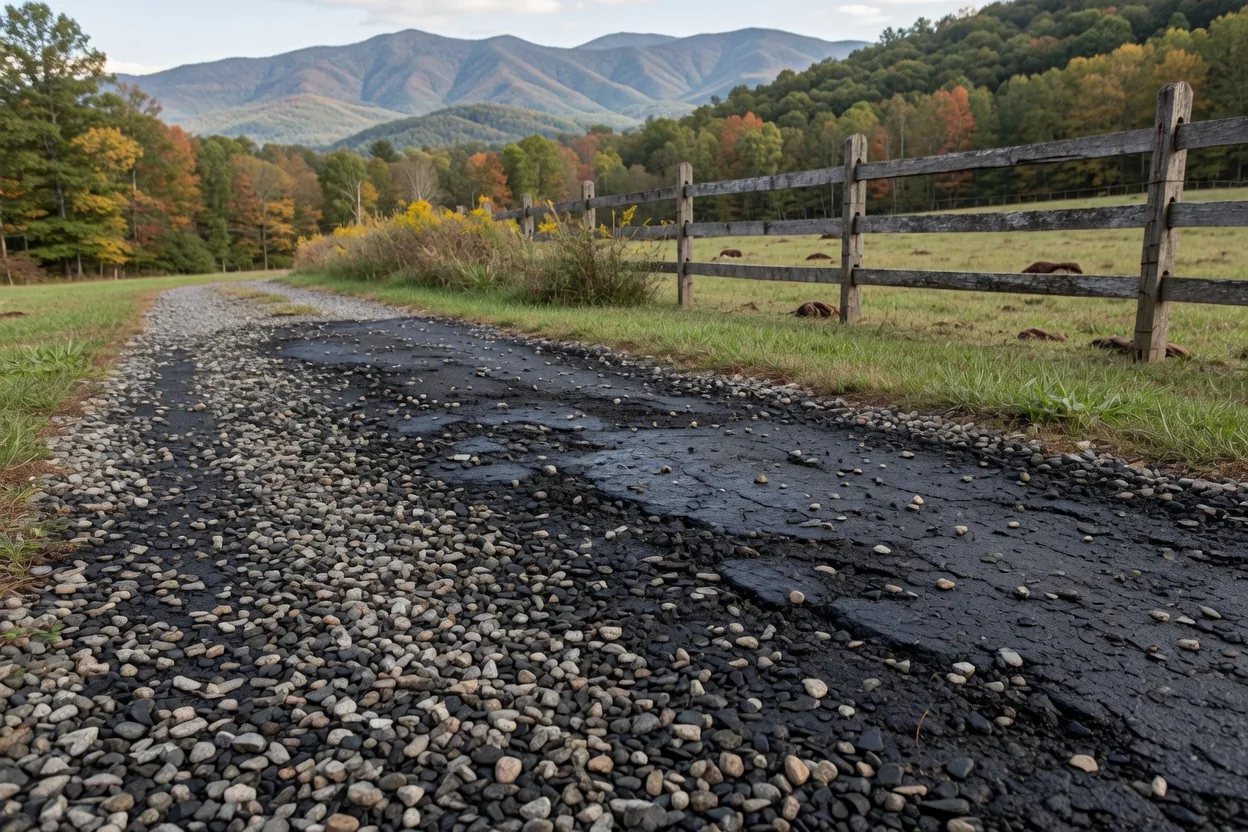
Not every pothole means the same thing, and confusing a surface problem for a base problem — or the reverse — is how homeowners end up paying twice. A shallow bowl with ragged edges in an otherwise firm surface usually points to localized moisture intrusion and surface oxidation. That pattern responds well to a proper hot-mix patch. A pothole with soft surrounding edges, a bowl that extends a foot or more across, or a cluster of potholes concentrated in one zone tells a different story: base failure, where the compacted gravel beneath the asphalt has shifted, washed out, or never settled correctly.
A simple field test worth doing before anyone shows up: press the asphalt surface around the pothole with your foot. Firm pavement that holds its shape points to a surface problem. Pavement that flexes, gives, or feels springy means the base underneath is compromised — and any repair applied on top of a failed base is a temporary measure, regardless of material quality. Widespread alligatoring (interconnected cracking across large areas) is the other red flag: once that pattern covers more than a third of the surface, patching individual holes rarely makes economic sense. The asphalt driveway repair guide covers the full diagnostic checklist a proper inspection should include.
Choosing between a patch, an overlay, and a full rebuild
The decision tree is straightforward once base condition is confirmed: isolated surface failure on a sound base calls for a patch; widespread surface wear on a sound base calls for an overlay; failed base anywhere under the surface calls for a rebuild. Applying a surface fix over a compromised base is not a repair — it is a delay.
| Scope | Typical Range | When it fits |
|---|---|---|
| Single hot-mix patch (1–3 holes) | $150–$400 per hole | Isolated surface failure, firm base confirmed |
| Multi-hole repair (4–8 holes) | $600–$1,500 | Scattered surface failures, base still sound |
| Overlay / resurfacing | $2,500–$6,500 | Widespread cracking or oxidation, solid subbase |
| Full base removal and rebuild | $6,500–$18,000 | Soft or failed subbase, major structural failure |
Steep driveways carry a line item that flat-lot bids rarely show: a proper drainage solution at the base of the grade. Leave that out and the new surface fails on a similar timeline to the old one — the water does not stop just because the pavement is fresh.
When slope and runoff are driving the failures
A driveway that runs downhill toward a garage apron, a street, or a neighbor's property is functioning as a drainage channel whether it was designed as one or not. If runoff channels down the center of the grade, pools at the low end, or undercuts the driveway edges, the potholes are a symptom of a water-management problem — not just a paving problem. Fixing the surface without redirecting the water means the same failures return within a few seasons.
The signs worth noting before any contractor shows up: a worn rut or depression running lengthwise down the driveway, potholes concentrated at the bottom of the slope or at the drainage low point, and visible erosion at the driveway edges after rain. The water-running-down-driveway page covers the grading, channel, and French drain options that should be on the scope before asphalt work begins. If the driveway approach connects to a state-maintained road, the NC Department of Transportation sets standards for how drainage at that connection must be managed — worth confirming before any work changes the outlet geometry.
What a reliable scope looks like in this market
Three questions sort the thorough bids from the incomplete ones: Does the estimate account for slope drainage, or does it price the surface only? Does the crew use hot-mix material for patching — a permanent repair — or cold-patch, which is a seasonal filler? And what does the base look like when they probe it, not just what the surface shows? A bid that skips any of those three is either assuming the best-case scenario or planning a return visit.
On permits: most patch and overlay work on an existing driveway footprint does not require a permit. Any work that changes the approach geometry, creates a new curb cut, or affects a state-road connection may require an encroachment permit through NCDOT Connect. Driveways inside Asheville city limits may also have encroachment requirements from the City of Asheville. Confirm before scheduling work that changes the driveway's footprint or drainage outlet — pulling a permit after the fact costs more than asking first.