Elevation changes what cracking means here
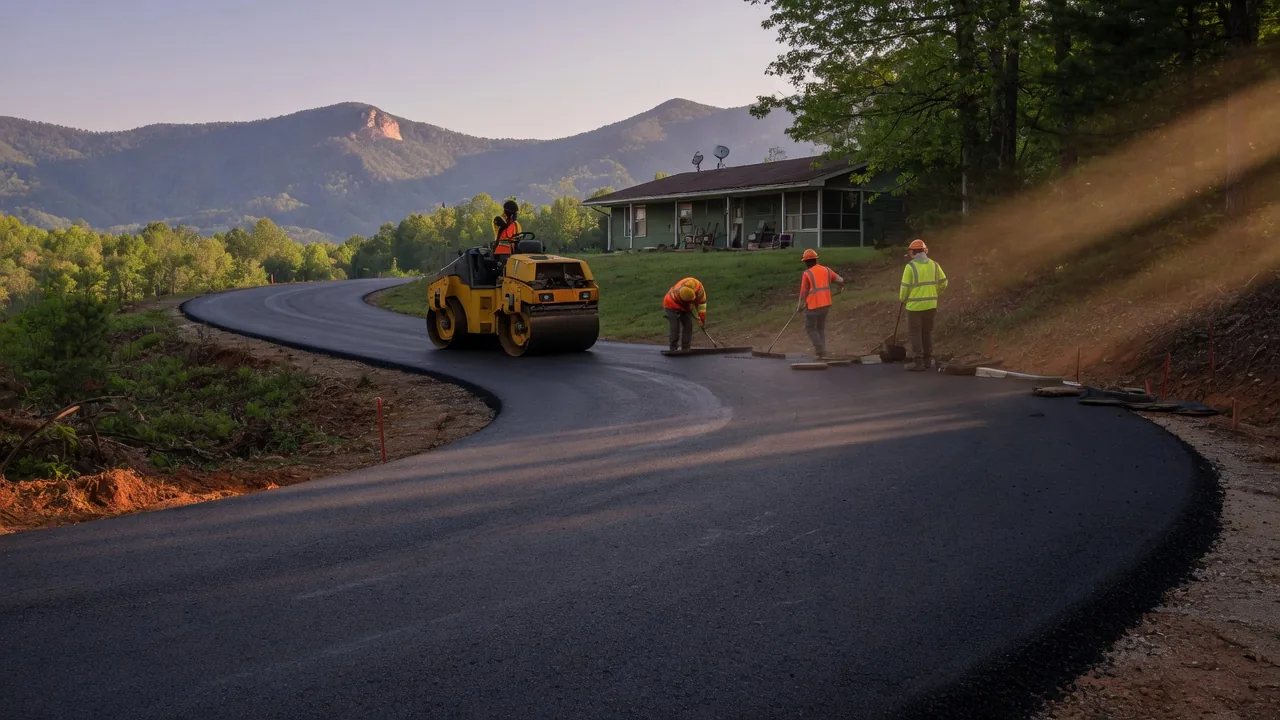
Asheville sits above 2,100 feet, and that elevation is the first thing a contractor should acknowledge before touching your driveway. The western NC mountains cycle through freeze and thaw more often per winter than the piedmont or the coast, and each cycle is mechanical: water enters a hairline crack, drops to 32 degrees, expands roughly 9 percent in volume, and forces the opening wider. By spring, what looked like a surface flaw has fractured the top course and started working on the base.
Slope compounds it. On a flat driveway, water ponds and eventually evaporates. On a driveway cutting up a ridge lot off Merrimon Avenue or grading down toward a valley entrance in Fairview, water travels — across the pavement surface, along the edges, and into every crack it can find on the way down. The combination of altitude-driven freeze-thaw repetition and active slope drainage is why asphalt driveway cracking in Buncombe County tends to progress faster than the product's projected lifespan, and why a diagnosis that ignores slope and drainage is incomplete before it starts.
Reading what the crack pattern is telling you
Not every crack represents the same failure, and misreading the pattern is how a $400 repair becomes a $4,000 replacement. Four types appear regularly in western NC residential driveways:
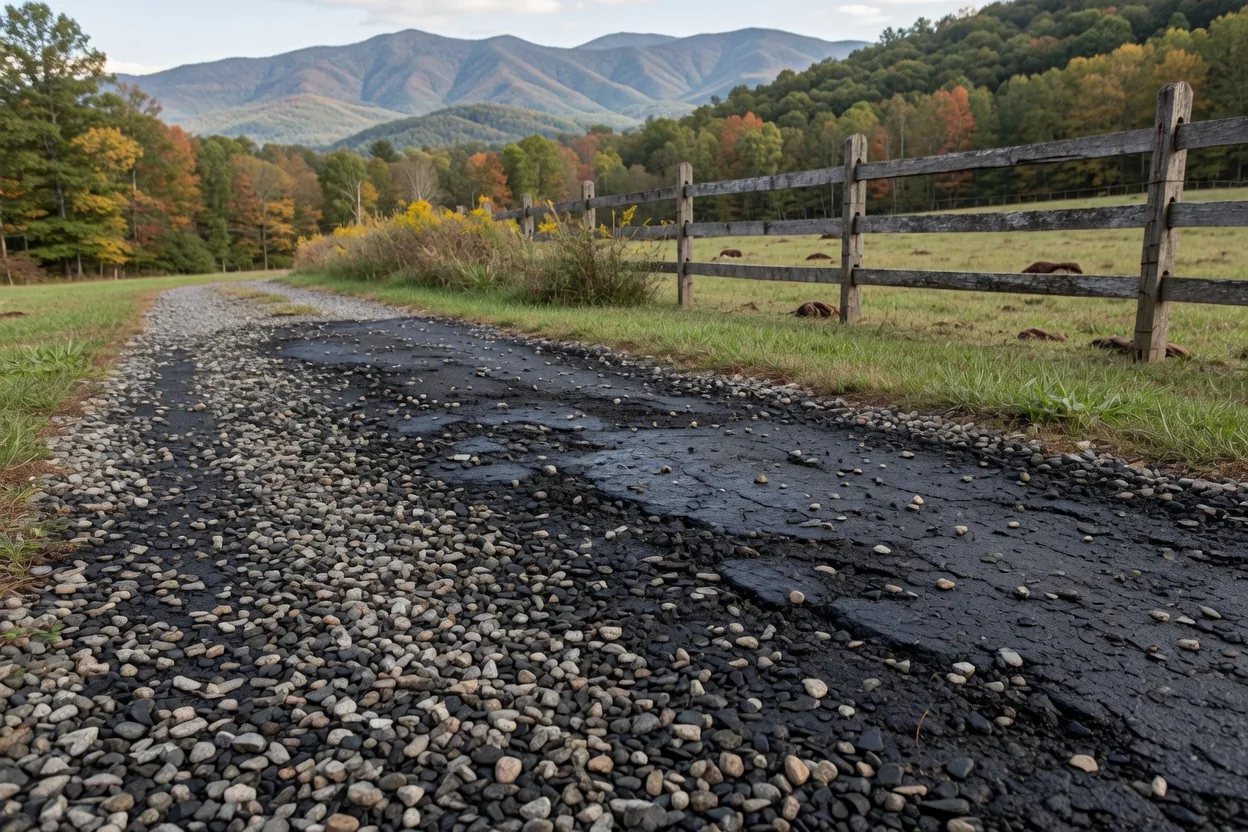
Alligator cracking — a network of interconnected cracks that resembles reptile scales — means the base layer beneath the surface has softened or shifted. This is not a surface problem. Applying sealer over it adds cost without addressing cause.
Edge cracking runs along the driveway border, usually where there is no solid shoulder holding the pavement edge in place. Common on mountain lots where mulch, grass, or exposed soil meets the asphalt without a proper edge transition.
Longitudinal cracking follows the direction of paving and often traces back to poor paving joint construction or thermal movement in a long run of asphalt on a steep grade.
Transverse cracking runs perpendicular to the paving direction and typically signals thermal contraction — pavement tightening in cold weather along its weakest points. Higher elevations see this earlier and more severely than lower-elevation NC communities.
Identifying which type you have before scheduling a contractor matters: the repair approach and the underlying cause differ. The repair guide walks through which fix matches which failure pattern.
What Buncombe County's storm record means for pavement
Buncombe County carries 19 federal disaster declarations spanning 1973-2026, the large majority tied to storm and flood events. That record describes the gap between what your driveway was engineered for and what it actually faces in a heavy rainfall year. The National Weather Service data for the Asheville area show annual precipitation well above the state average, arriving in high-intensity bursts that overwhelm surface drainage faster than a steady rain of equal total volume.
The practical effect on asphalt: downspout discharge running onto the driveway surface, improper grading directing yard water across the slab, and missing edge drainage all accelerate cracking faster than age alone. Standing water at the pavement edge is almost always visible before alligatoring shows up — it is the warning the problem gives you before the repair bill arrives.
Fixing drainage before patching asphalt is the correct sequence, not an optional upgrade. A patch applied while the water problem persists reopens on roughly the same timeline as the original damage.
Repair scope and what it costs in this area
Cost depends on crack type, square footage, and whether the base needs work before the surface can hold a repair. The ranges below reflect typical Buncombe County contractor pricing — treat them as starting points for a real scope conversation, not flat rates. Slope adds labor time and material; any driveway pitching more than 8 percent requires additional tack coat work that flatland quotes rarely include automatically.
| Damage type | Repair scope | Typical range |
|---|---|---|
| Hairline or shrinkage cracks | Crack filler, seal | $200–$500 |
| Edge cracking (linear sections) | Edge patching, shoulder re-grading | $400–$900 |
| Pothole or localized failure | Cut, base repair, hot-mix patch | $300–$900 per area |
| Alligator cracking (moderate coverage) | Full-depth patch, base recompact | $800–$2,500 |
| Widespread surface failure | Mill and overlay or full resurface | $2,500–$6,000+ |
See the full repair breakdown for line-item detail by damage type and what a proper scope visit should include.
Where sealing helps and where it stops helping
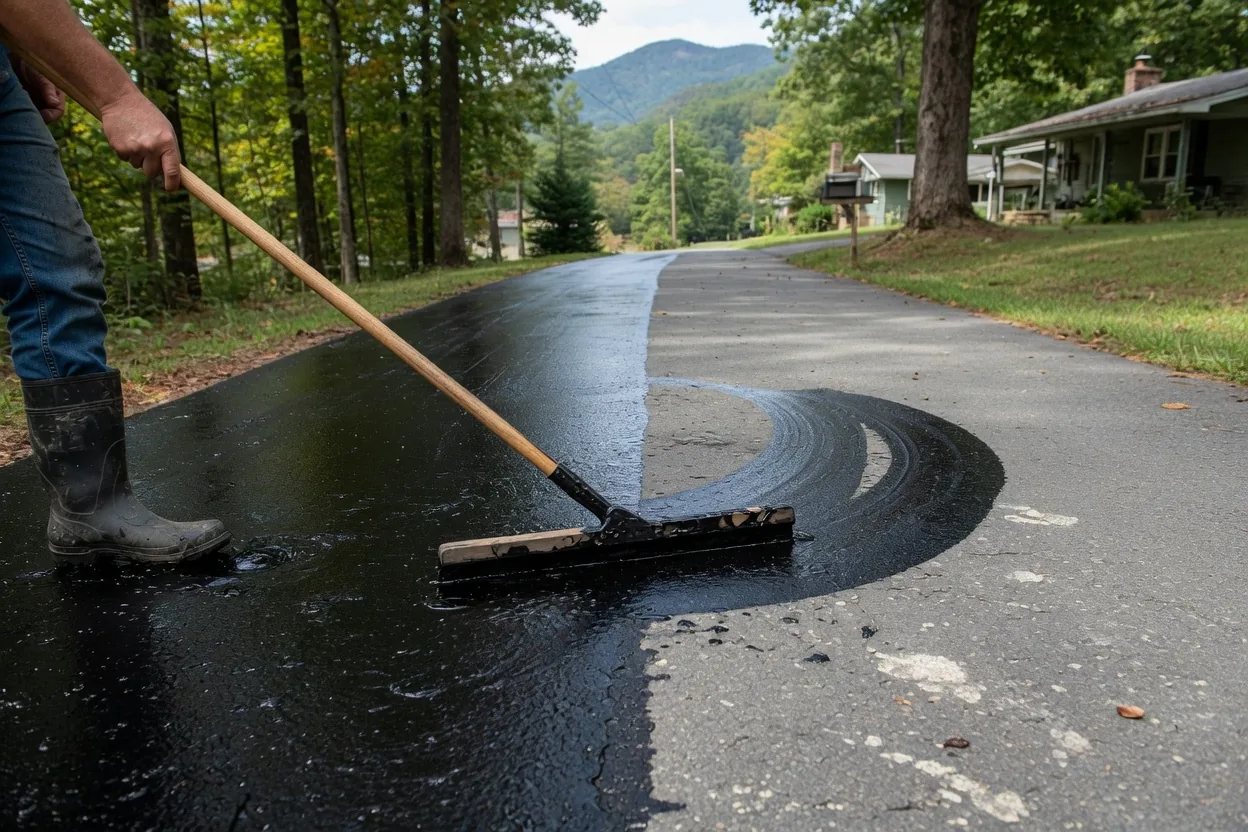
Sealcoating closes surface pores against water infiltration and UV oxidation — it is a maintenance tool, not a structural repair. Applied over alligator cracking or base failure, it seals in the problem. Most contractors who do the work will say so upfront; the ones who don't are worth walking away from.
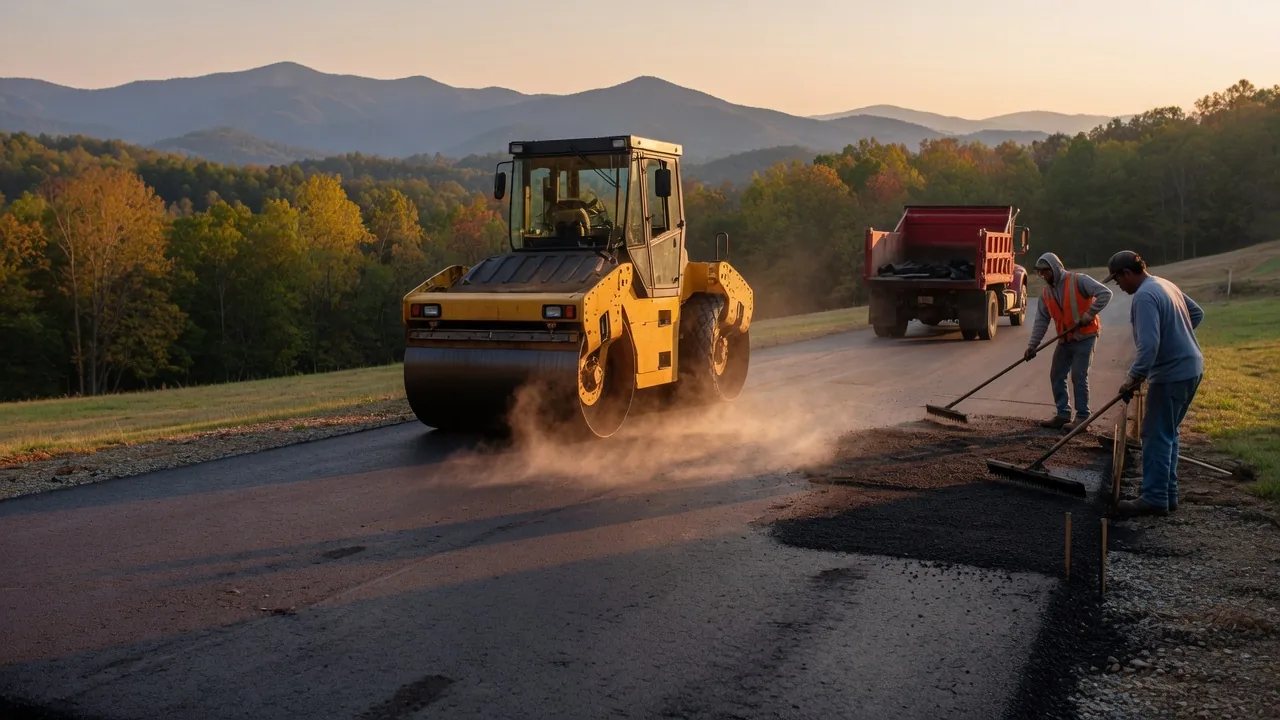
The decision between patching, resurfacing, and full replacement comes down to base condition and how much of the surface is affected. If the base is intact and cracking is surface-level, patch and seal is the right call. Once cracking covers more than a third of the driveway or the base has softened in sections, resurfacing delivers better long-term value than accumulated patching. Full replacement becomes the answer when the sub-base has moved — common on older installations on steep lots that were never properly compacted at the time of installation.
One practical note for Asheville-area lots: the NC Department of Transportation requires a driveway permit for any work connecting to a state-maintained road. Confirm your road's maintenance status before work starts; the application process runs through NCDOT Connect.
What a complete estimate looks like
A well-run estimate for asphalt cracking repair includes a look at the base, not just the surface. Ask whether the contractor plans to probe or cut into any alligatored sections before quoting a patch — if the answer is no, the quote is not complete. Ask how slope drainage is handled before paving restarts. And ask what the expected lifespan of the proposed repair is given the drainage conditions on your lot.
For Asheville-area projects, the City of Asheville development office can confirm whether a local permit is required; requirements vary by project size and connection to city infrastructure. Driveway connections to NCDOT-maintained roads require a separate state-level permit regardless of city requirements.