Why Arden driveways fail the way they do
Arden occupies the southern end of Buncombe County where the terrain relaxes from Asheville's ridgelines into the broader valley running alongside I-26. The neighborhoods here — Skyland, the subdivisions off Long Shoals Road, and the residential streets that filled in through the 1970s and 1980s — mostly sit on valley-floor soils that run significantly heavier in clay than the rocky substrate of ridge-top builds above the city. That distinction matters for asphalt.
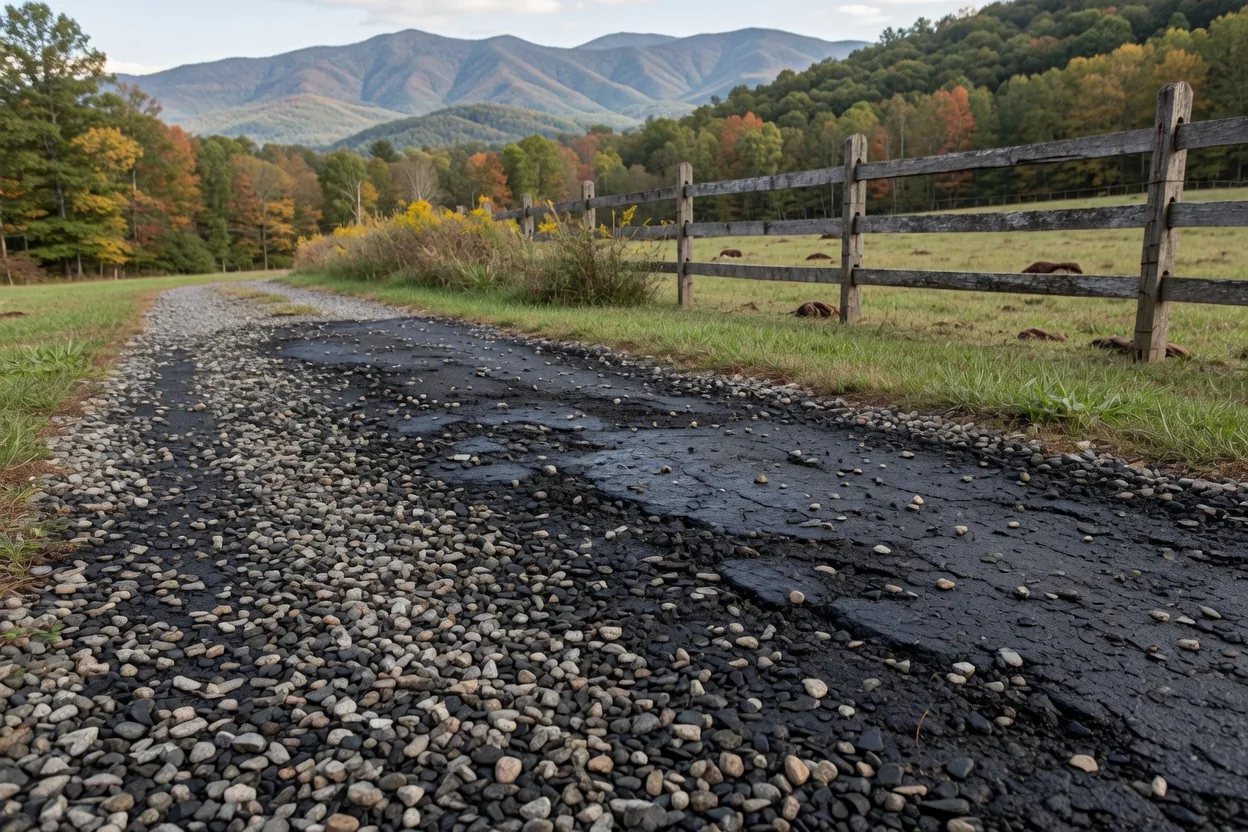
Clay swells when it absorbs water and contracts again as it dries, repeating that cycle every year. A driveway base built on clay is never entirely stable; it moves seasonally. Over years, that movement telegraphs upward through the asphalt as wide-area fine cracking — often called alligator or fatigue cracking — that originates below the surface, not from surface wear. Sealing those cracks without addressing the base movement buys a season or two before the same pattern returns.
Reading which type of failure you have is the starting point for any asphalt driveway repair that actually holds. Surface wear cracks running parallel to traffic direction behave differently than base-failure cracking, and the fix for one does not hold for the other. The full breakdown of crack pattern types is on the driveway cracking guide.
What repairs cost, scope by scope
The extent of the damage drives the number more than the driveway's square footage does. A hairline crack sealed before water infiltrates is the cheapest intervention a homeowner makes; a full-section removal with base rebuilding is the most expensive. The table below covers the common repair scopes a residential driveway in Arden typically needs.
| Repair scope | Typical range |
|---|---|
| Crack sealing (surface cracks, solid base) | $250–$700 |
| Pothole patching (1–3 potholes) | $300–$650 |
| Alligator section removal and patch | $600–$1,800 |
| Mill and fill (per 100 sq ft) | $900–$2,500 |
| Full driveway overlay or replacement | $2,000–$4,500 |
Drainage conditions and base health are the two factors that push a job toward the top of its range. A driveway with standing water at the low end or soft spots that flex underfoot costs more to repair correctly than one with identical surface area but a sound base. Any estimate showing a flat per-square-foot number with no mention of base assessment is worth a second look at what it omits.
The water problem underneath
Buncombe County carries 19 federal disaster declarations on record (1973-2026), most of them tied to storm and flood events. Each significant weather event moves water against asphalt that was laid to a drainage assumption based on average years. When that assumption breaks down — a swale filled in during a later addition, a downspout discharging at the driveway, uphill runoff concentrating at the low corner — the base absorbs moisture on a schedule the original design never anticipated.
Sustained base saturation does two things to asphalt. First, it softens the soil beneath the stone base layer, allowing the base to shift and the asphalt above to flex and crack. Second, in Buncombe County winters where temperatures cross freezing repeatedly between December and March, water held in the base expands and pries existing cracks wider. The National Weather Service climate data for the Asheville area documents the freeze-thaw cycles common to western North Carolina winters; the mountain elevation means more frequent crossings than in the piedmont.
Driveway potholes that return within a season of patching are the most common signal that the underlying drainage situation has not been addressed. Before any patch goes down, where the water is coming from has to be answered first.
When NCDOT is in the picture
Work that changes how a driveway connects to the road — widening the apron, adding a curb cut, regrading the entrance to a state-maintained route — touches the right-of-way and requires a permit from the NC Department of Transportation. Arden is unincorporated Buncombe County, and many of its residential streets are NCDOT-maintained state routes rather than county roads. The jurisdiction question needs an answer before equipment moves in, because the permit process differs: state-route work runs through NCDOT while county-road work goes through Buncombe County public works.
Permit applications for NCDOT right-of-way work are submitted through NCDOT Connect, the department's online portal. A contractor who skips this step leaves the property owner responsible for correcting the violation, which can mean removing and rebuilding work already done.
Repairs that stay within the property line — crack sealing, pothole patching, resurfacing — generally do not require a permit. When any scope approaches the road edge, the contractor should confirm jurisdiction and permit requirements before starting.
Hiring for this ground
Three questions separate an Arden asphalt crew that does lasting work from one that moves fast and moves on. First: have they worked on clay-base driveways in this valley, or primarily on the compacted fill and rock common to ridge-top lots? The base prep is different, and crews experienced with one terrain do not automatically translate to the other. Second: what is their base-assessment step before paving begins? A crew that quotes from photographs or skips probing the base is not completing the evaluation. Third: does any part of the scope involve the road edge, and if so, are permits accounted for in the plan?
The answers tell you more about the quality of the work than the number on the quote does. A bid that arrives unusually low with no base-prep line item is typically a sign that the step most likely to determine whether the repair lasts five years or twenty is missing from the scope.
When you are ready for someone to look at it, use the form on this page. Jobs with active damage — a pothole that appeared this season, cracking that accelerated over the last winter — get priority scheduling.