Two permit tracks, one mountain county
Asheville sits in a mountain basin threaded by state-maintained roads — US 19, US 23, US 25, US 70, and dozens of secondary routes that look local on a map but sit in NCDOT's right-of-way. North Carolina maintains more secondary road miles than nearly any other state DOT, so the NCDOT driveway permit requirement reaches further into residential neighborhoods than homeowners expect — including rural Buncombe hollows and ridge-line subdivisions that feel remote from any agency office.
That geography creates two distinct permit tracks. The first is the NCDOT driveway permit, applied through NCDOT Connect, required whenever a new or substantially modified driveway approach crosses a state right-of-way. The second is a local right-of-way encroachment permit from the City of Asheville, which applies to any work in or adjacent to a city public right-of-way inside the corporate limits. Some projects touch both tracks; work that sits entirely on a private road or an unincorporated parcel with no state-road frontage may touch neither — but that window is narrower than most homeowners assume.
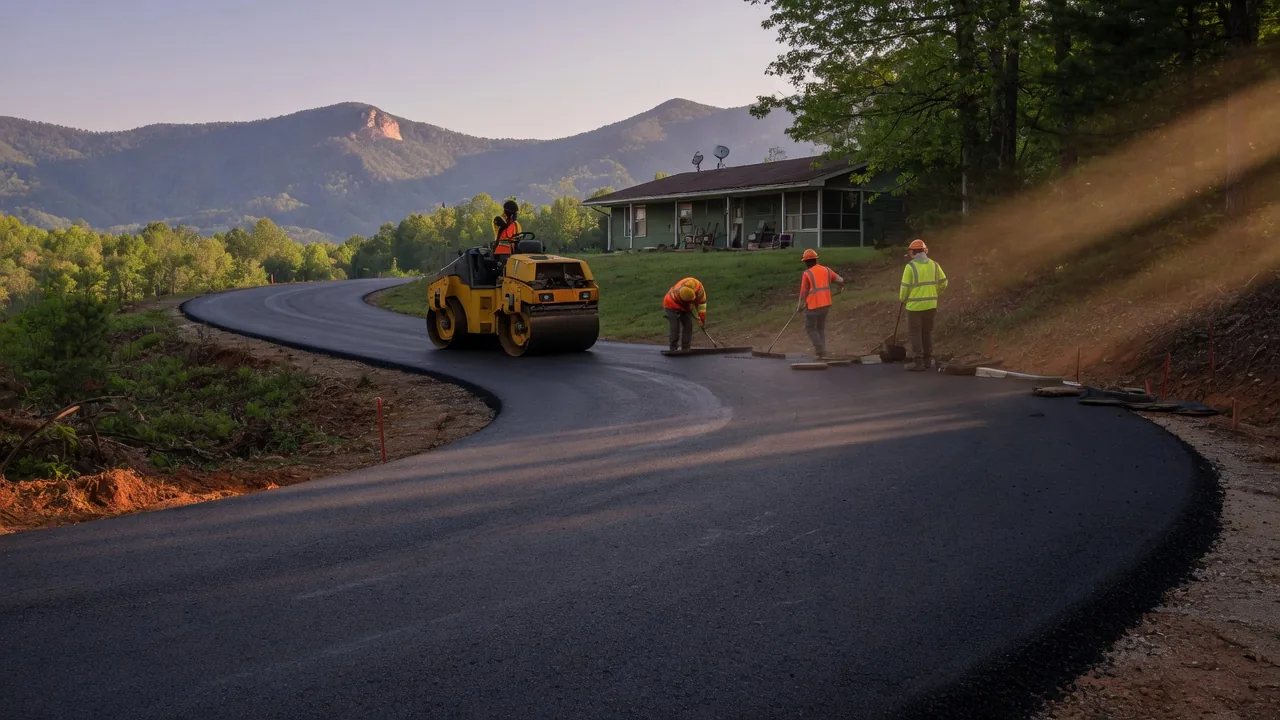
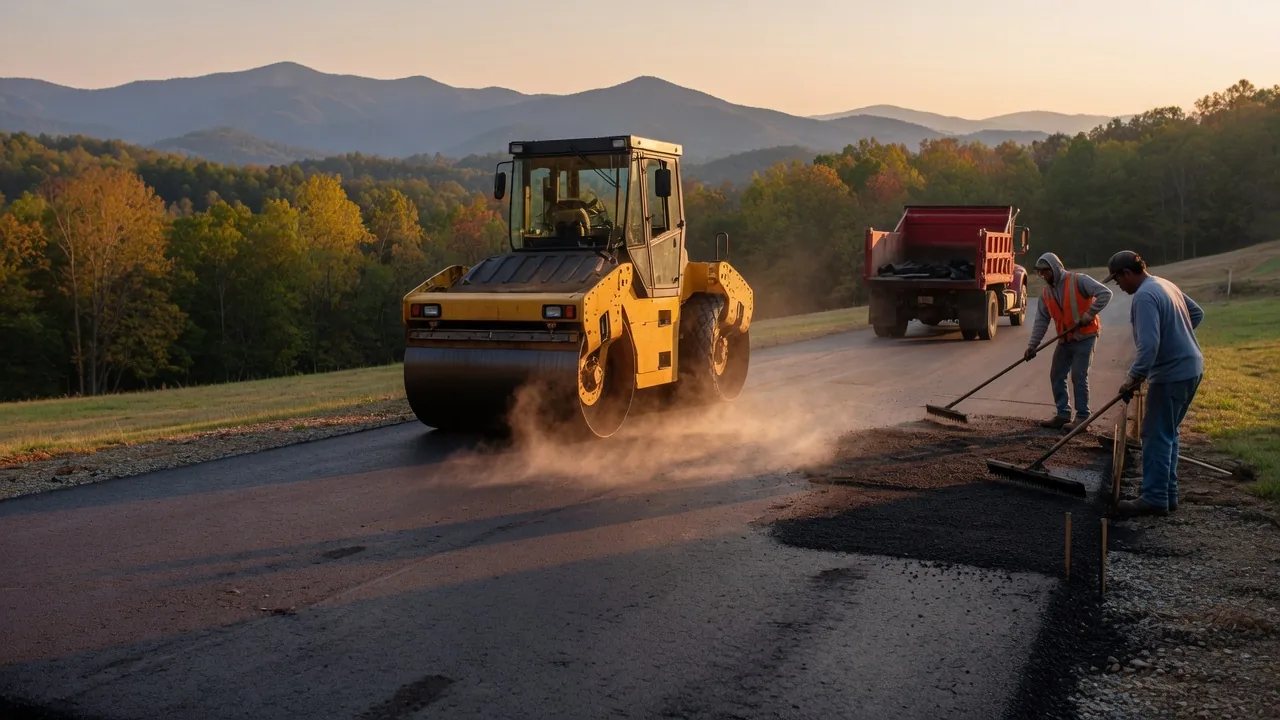
Understanding which track governs your project is the first question to settle before calling a contractor. For a broader view of what the paving itself involves on these mountain slopes, see our asphalt paving overview.
When a permit is required — and when it isn't
The practical decision for most Buncombe homeowners hinges on two questions: does the driveway touch a state or city right-of-way, and does the scope change the drainage footprint?
| Work | Permit required? |
|---|---|
| New driveway connecting to a state-maintained road | Yes — NCDOT driveway permit via NCDOT Connect |
| New or relocated curb cut within Asheville city limits | Yes — City of Asheville right-of-way encroachment permit |
| Widening an existing driveway approach | Yes — NCDOT and/or city permit depending on road status |
| Adding or resizing a culvert under the apron | Yes — NCDOT drainage review required for state roads |
| Repaving existing driveway (same width, no drainage change) | Generally no |
| Major grading or retaining wall on a sloped lot | Land-disturbance or grading permit may apply — confirm with county |
One category that catches homeowners off guard: a straightforward repave — stripping worn asphalt and laying fresh material over the same footprint — generally does not require a new permit if width, entry angle, and drainage path are unchanged. The moment you widen the approach, relocate the curb cut, or change the drainage slope, the permit requirement is triggered. Culverts are a common additional trigger in this terrain; if your apron crosses a roadside ditch and needs a pipe, NCDOT will want to review the sizing before installation.
How the NCDOT application actually works
Residential driveway permit applications go through NCDOT Connect, the department's online portal. A complete submission for a standard residential approach includes a site sketch showing driveway width, centerline entry angle relative to the road, sight-distance measurements in both directions, and a drainage note describing how runoff will leave the apron without concentrating onto the travel lane or adjacent property.
NCDOT reviews principally for two things: sight distance — can a driver pulling out of the driveway see oncoming traffic clearly enough to merge safely? — and drainage — will the modified approach redirect runoff in ways that damage the road or a neighbor's property? In Buncombe County's ridge and hollow topography, that second question carries extra weight. Roads cut into hillsides have limited tolerance for concentrated new runoff; an application that arrives with a clear drainage narrative moves through review faster than one that leaves the engineer to guess.
Approval timelines for complete residential applications are typically measured in weeks, not months. An incomplete submission — missing the sight-distance sketch or a readable culvert detail — gets returned for resubmission and restarts the clock. If the terrain calls for serious earthwork before the apron can even be graded, the steep driveway paving page explains what that scope of project typically involves before the permit drawing is framed.
What Asheville's local permit layer adds
Inside Asheville's city limits, the City of Asheville requires a right-of-way encroachment permit for any work in or adjacent to the public right-of-way — which typically extends several feet beyond the back of curb or edge of pavement on residential streets. That reach means almost any work involving an apron, curb cut, or approach pad in the city touches local jurisdiction, even when NCDOT is not also involved.
The city's application asks for driveway dimensions, ADA-compliant apron cross-slope (accessibility standards apply even on residential approaches), any potential impact to mature street trees in the right-of-way, and a basic stormwater drainage plan. The underlying code reference is the NC Residential Building Code, published under the authority of the NC Department of Insurance – Engineering & Building Codes; the city's inspections department enforces it locally.
For unincorporated Buncombe County addresses outside the city, the county's Inspections department handles local permitting; the NCDOT track still applies in parallel for any state-road frontage. Before signing a paving contract, confirm the contractor holds the appropriate license for the scope of the work — see NC paving contractor license requirements for the thresholds that matter.
What skipping the permit costs in mountain terrain
Unpermitted driveway work in Buncombe County carries consequences that are harder to absorb than on flat terrain. Western NC has accumulated 19 federal disaster declarations over 1973-2026, most of them water-driven: flooding, debris flows, and slope failures on saturated hillsides. An unpermitted apron that redirects storm runoff onto a neighbor's lot or the road edge creates a liability exposure that a properly reviewed drainage plan would have caught before any material was placed. The permit and its associated drainage review are, in practice, a low-cost engineering peer review on a decision that is very difficult to undo after the fact.
The second consequence is resale. A buyer's inspector who finds a widened driveway with no permit record flags it; the deal either pauses while the seller retroactively permits it — at current fee-schedule rates, with whatever inspection the jurisdiction requires to close it out — or the uncertainty gets priced into negotiations, rarely in the seller's favor. The third consequence is contractor accountability: a permitted, inspected job is a documented job. If the base fails in year two because it was not compacted to spec, the permit and inspection record is the evidence that establishes what was or was not verified during construction. A job that skips the permit skips that protection entirely.