Slope is the variable the square-footage estimate ignores
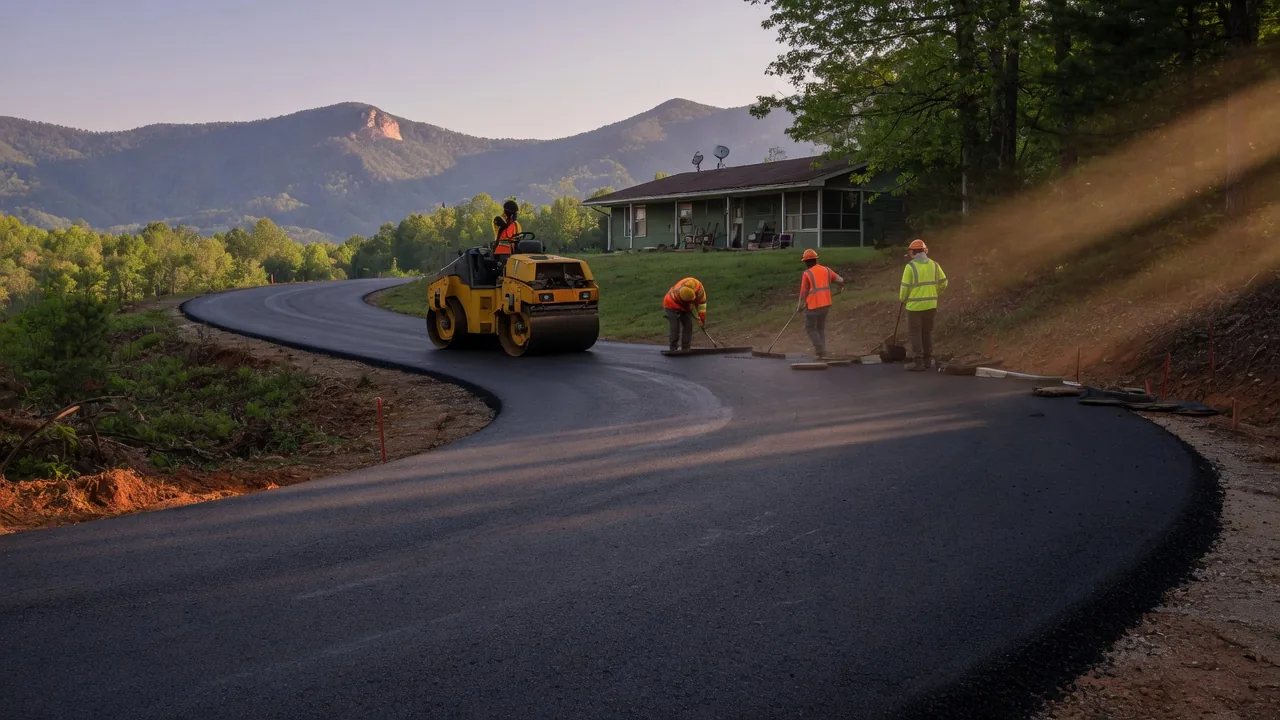
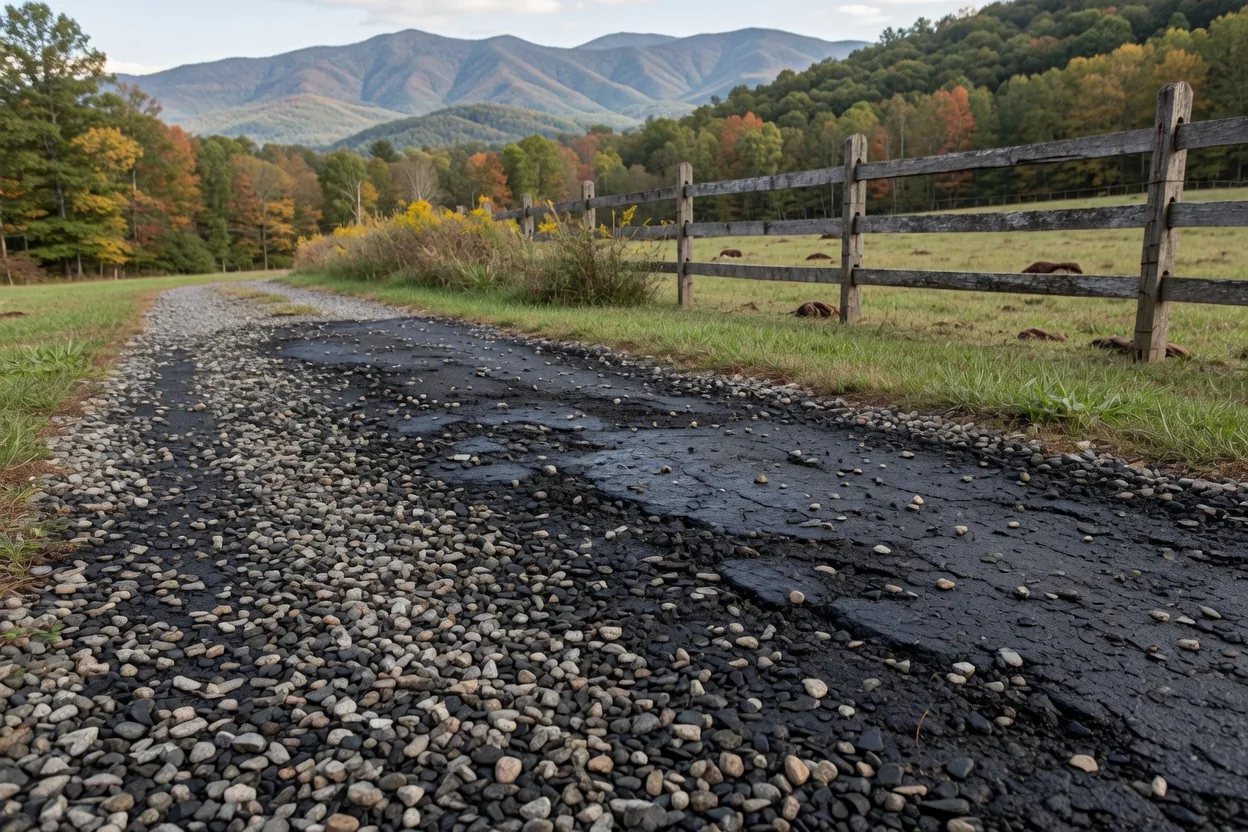
Most residential driveways in Buncombe County run uphill. A hillside lot off Merrimon, a long approach above West Asheville, a steeper pull out toward Leicester or Swannanoa — grade is the norm here, not the exception, and it changes what a gravel-to-asphalt conversion actually costs. Grade is also what has been migrating your gravel downhill through every wet season. By the time a paving crew arrives, the base under most mountain driveways is uneven, thin in low spots, and carrying far less aggregate than it started with.
The National Weather Service records annual rainfall in the Asheville basin well above national averages, and the French Broad River watershed drains the entire valley. That rainfall history means drainage is not an afterthought on a paving job here — it is the axis the whole job turns on. A properly graded and crowned surface sheds water to the edges and protects the stone base for decades. Asphalt laid over a compromised or poorly crowned base develops edge cracks and centerline failures within a few seasons, and patching those never pencils out against doing the groundwork right the first time.
Buncombe County has 19 federal disaster declarations on record spanning 1973-2026, the majority tied to severe weather and flooding events. Saturated-soil seasons are exactly when marginal gravel bases announce their weakness, and when driveways that were serviceable the year before suddenly are not.
What actually happens between gravel and finished pavement
A gravel-to-asphalt conversion is not a paving job with a few extra steps. It is a base-construction project that ends with paving, and the sequence matters:
- Base assessment and gravel survey. The crew evaluates existing material to determine how much is usable dense-graded aggregate versus fine stone dust or contaminated fill. Gravel pushed to the drive edges is often reclaimable, which is where some of the cost efficiency of a conversion lives compared to starting from bare ground.
- Regrading and crown establishment. The surface is laser-graded to a 2–4 percent crown so water breaks to the edges rather than pooling at center or tracking straight down the fall line. On a sloped mountain drive, cross-slope grades and edge drainage transitions are part of this stage.
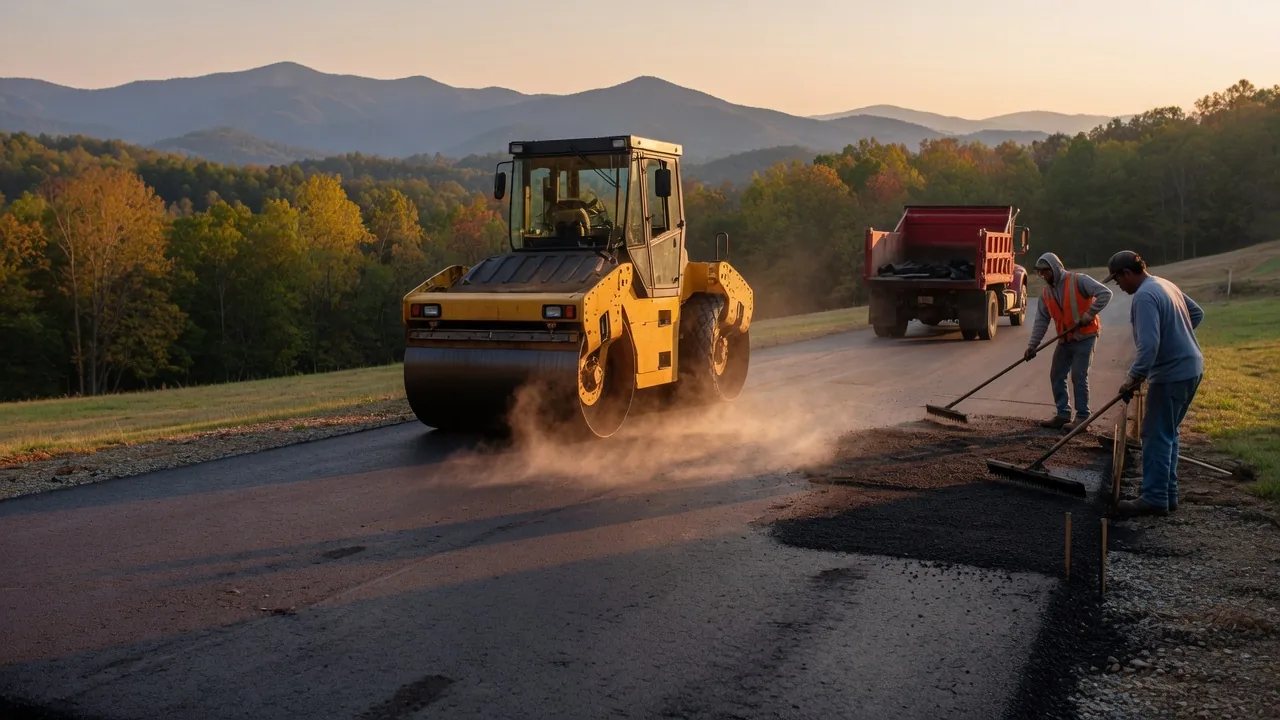
- Aggregate base compaction. New crushed stone is added where the existing base is thin, and the full lift is compacted to a minimum 6–8 inches of dense-graded aggregate. This is the stage where shortcuts on lower bids show up years later as premature surface failures.
- Asphalt installation. Hot-mix asphalt is placed in at least one lift — two lifts is better for any drive with meaningful grade or regular vehicle traffic — typically 2 to 3 inches of compacted material for residential use.
- Edge restraint and drainage tie-ins. Paved edges without restraint or proper drainage transitions ravel quickly. This step is frequently abbreviated on the lowest bids and expensive to correct after the fact.
For a detailed breakdown of how base conditions affect total scope and price, the cost-to-pave-a-gravel-driveway guide covers driveway size and site condition variables in depth.
What the job costs and what moves the number
Per-square-foot pricing for a gravel-to-asphalt conversion in Buncombe County generally runs $6 to $14. The spread is wide because base condition is rarely known with precision until the crew is on site. What looks like a solid gravel driveway from the surface can be two inches over subgrade, or a well-built eight-inch base that needs only minor correction. Depth to stable subgrade is the wildcard; slope lots and those with a history of water intrusion price toward the higher end of the range.
| Job scope | Typical size | Per-sq-ft range | Estimated total |
|---|---|---|---|
| Small flat drive, solid existing base | ~600 sq ft | $6–$10 | $3,600–$6,000 |
| Average driveway, base regrade needed | ~1,100 sq ft | $7–$12 | $7,700–$13,200 |
| Long or sloped mountain drive, drainage included | ~1,500 sq ft | $8–$14 | $12,000–$18,000 |
| Complex grade or switchback, drainage structures required | Varies | $10–$14 | Toward upper range |
Asheville's sustained residential investment over the past decade means many older properties are converting driveways that have carried decades of deferred base maintenance. On those jobs, the base work often rivals the paving cost — and the bids that look cheapest on square footage are frequently the ones that omit this reality from their scope.
When a permit is required and when NCDOT has jurisdiction
Most driveway paving that stays entirely on private property in unincorporated Buncombe County does not require a grading or construction permit. Two situations change that calculus and are worth knowing before work begins.
First, if your driveway connects to a state-maintained road — which covers a large share of rural Buncombe addresses — the driveway approach within the NCDOT right-of-way is state property. Replacing a gravel approach with asphalt, widening a culvert, or altering the apron geometry typically requires a driveway permit submitted through NCDOT Connect. Performing the work without it can result in the state requiring removal and full restoration at the homeowner's expense — not a hypothetical outcome in this region.
Second, addresses within Asheville city limits fall under City of Asheville jurisdiction. The city's land disturbance and stormwater ordinances may apply to paving projects that materially increase impervious cover or alter drainage patterns. A brief pre-application call to development services before work starts is worth the time if the project is substantial or the property sits near a regulatory boundary.
A contractor who works Buncombe County regularly will know which roads in your area are state-maintained and whether your approach requires a permit before the first machine rolls in — that familiarity is part of what you are paying for in local experience.
What asphalt fixes and what it leaves unchanged
Asphalt eliminates dust, mud, and the continuous stone migration that makes gravel drives a recurring maintenance line. For most Buncombe County homeowners, the trade is straightforward: a paved surface that stays where it is, sheds water cleanly, and does not need periodic regrading or fresh stone every few years.
What asphalt does not change: your drainage patterns. A gravel driveway that floods at the base or routes runoff across a neighboring property will have exactly the same problem in asphalt unless the grading and drainage work addresses the actual water path — and a paved, impervious surface can concentrate runoff faster than the gravel did. This is the conversation to have at the estimate stage, not after the surface is down.
If texture and character matter as much as sealing, tar-and-chip is worth pricing alongside asphalt. It uses the same compacted base but finishes with a chip-seal surface that blends better with wooded and mountain settings, typically costs less per square foot, and handles thermal movement more forgivingly on long rural drives. For a full comparison of paved surface options available in this region — including maintenance timelines and long-term cost differences — the asphalt paving overview covers what to expect from each type in a western NC climate.
The questions worth pressing before you sign a paving bid
"What is the base condition and what specifically are you doing about it?" A bid that quotes only square footage without itemizing base preparation is assuming your existing gravel is ready to carry asphalt. On most Buncombe County mountain driveways, it is not. Ask for a written scope that separates regrading, stone addition, and paving so you can see the base work as a line item, not a footnote.
"How do you handle drainage at the edges and the top of the grade?" Water that tracks down the center of a sloped driveway rather than shedding to the edges will undermine the base within a few years. Ask how crown and edge transitions are handled and whether any drainage structures are in scope or excluded. The NC Department of Insurance administers building codes that address stormwater management for paved surfaces; a contractor working to those standards should answer this question directly, not deflect it.
"What asphalt thickness are you installing, and in how many lifts?" A residential driveway in this region warrants at least 2 inches of compacted asphalt over a solid aggregate base; anything with meaningful grade or heavier vehicle use warrants 2.5 to 3 inches in two lifts. A bid that does not specify thickness is one worth pressing before you sign.