What mountain terrain actually changes about this job
Buncombe County sits in a bowl of ridges where most residential lots tilt at grades a flatland paver would never quote on. The hollows and hillsides around Asheville push driveways into steeper angles than most of the state, and that grade changes the job in three directions at once: how base material is placed and at what depth, how runoff is channeled before it undermines the subgrade, and how hot-mix asphalt is laid without slumping before it cures. Get one of those wrong and the driveway is a short-term fix dressed as a permanent one.
The soil adds a second complication that doesn't show in a grade measurement. Mountain lots in this county commonly sit on residual clay derived from weathered metamorphic rock — it holds moisture, expands in wet seasons, and contracts when dry. That movement is what base depth is engineered to absorb: a base section adequate on a flat piedmont lot is often undersized here. Western North Carolina is among the wettest regions east of the Rockies, and that rainfall reality means the drainage read on a steep driveway is not optional paperwork; it is the engineering step that determines whether you're solving the problem or postponing it. The fundamentals of asphalt paving don't change on a steep lot — but every decision gets amplified by the grade.
What installation on a steep Buncombe lot actually involves
The sequence matters more on steep terrain because each phase sets up the next:
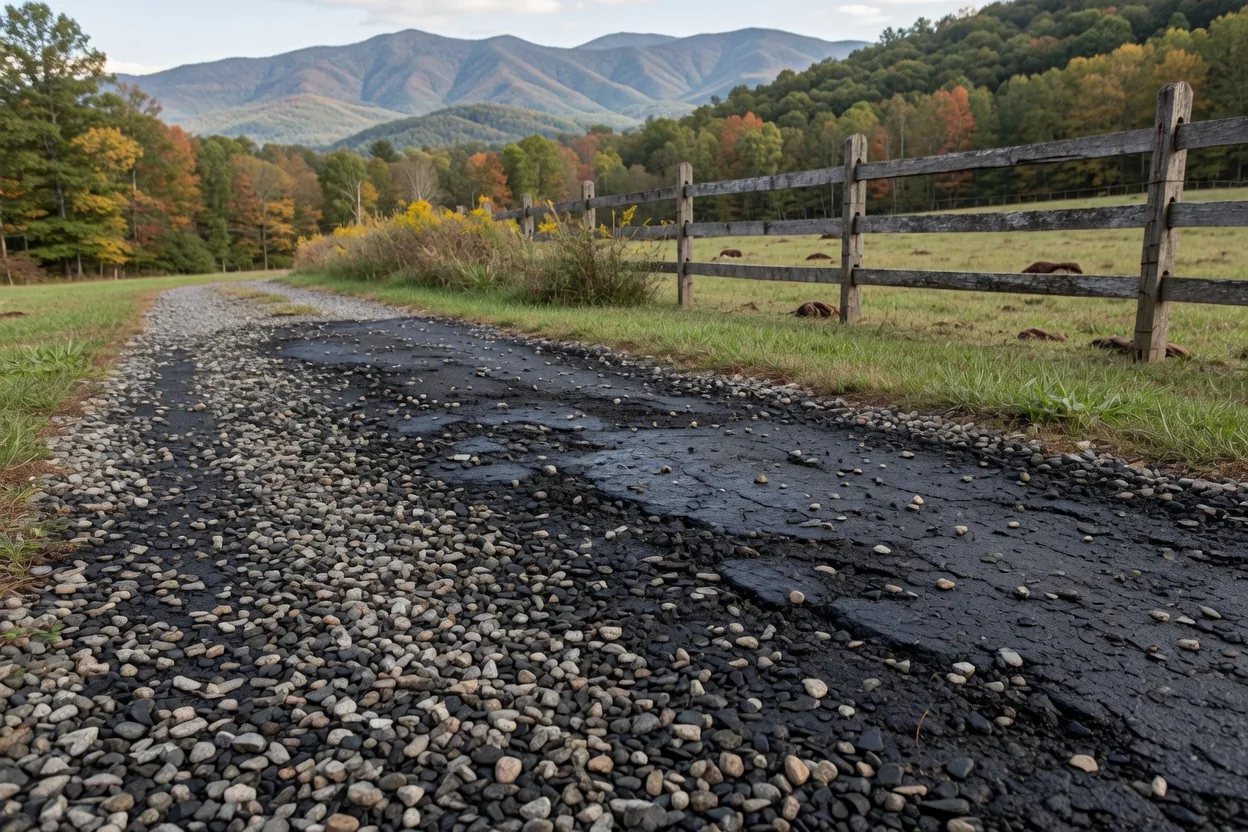
- Site survey and drainage design. Before a grader runs, water's path down the slope needs a mapped exit: a swale, a pipe, a catch basin. Water moving down a steep driveway on these grades carries enough volume to wash subgrade out from under brand-new asphalt inside a single rain season — and on Buncombe's terrain, that season arrives reliably.
- Subgrade prep and base installation. Excavation removes unstable material; compacted aggregate base follows, built thicker on steeper grades and in wetter zones than minimums used on flat suburban work. The ICC residential grading and drainage provisions set a code baseline, but mountain clay routinely demands more than minimum.
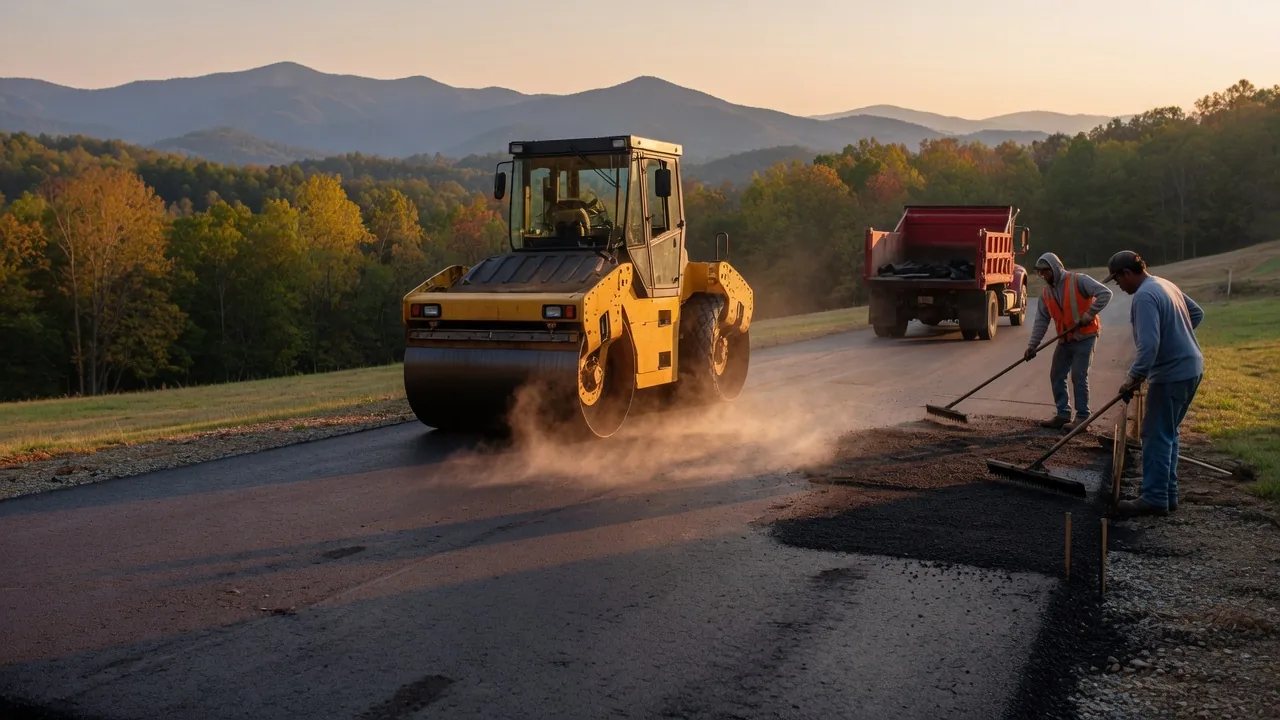
- Mix delivery coordination. Hot-mix asphalt starts cooling the moment it leaves the plant. Mountain routes add drive time, and if the plant sits across the county or over a ridge, a truck can arrive near the edge of its laydown window. Experienced contractors know which plants serve western NC mountain lots reliably and schedule deliveries around that constraint.
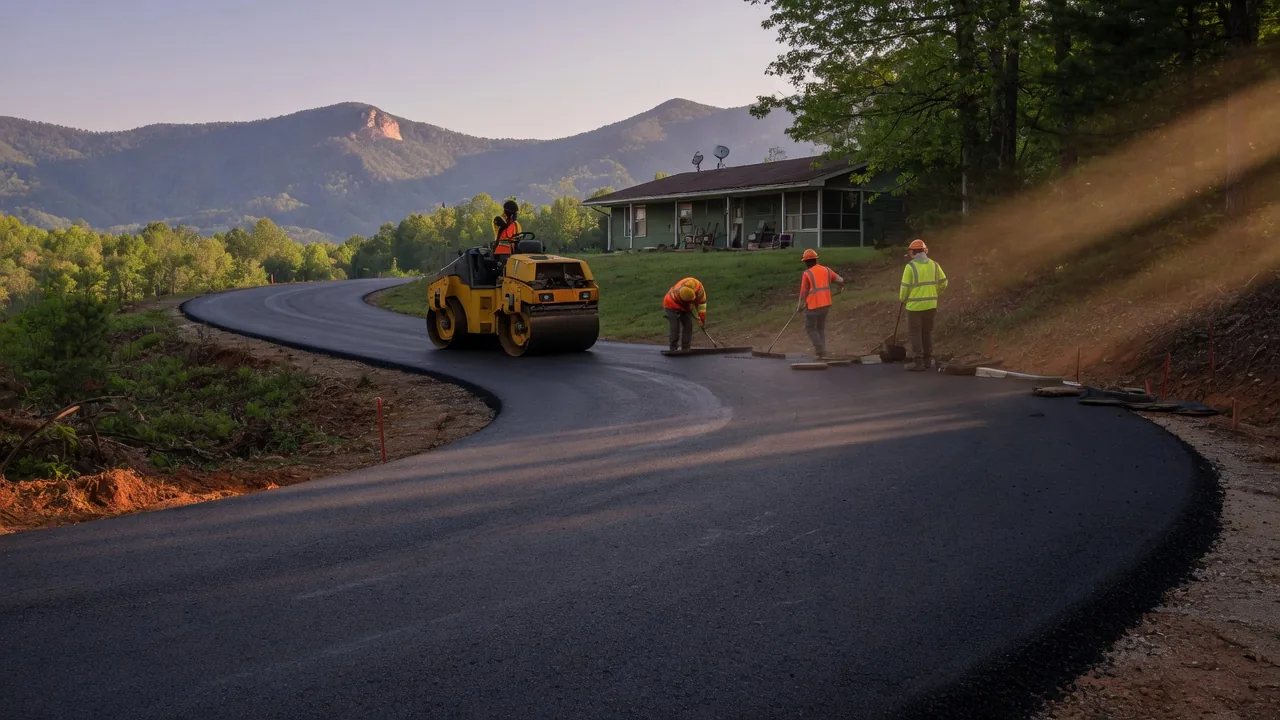
- Paving the grade. Crews work uphill to maintain consistent mat thickness and time roller passes to prevent displacement on the slope. Asphalt rolled too hot or too cool on a steep grade will not compact evenly — timing is the craft, not just the equipment.
- Drainage structures. Edge drains, catch basins, or channel drains at the base of the grade keep water from pooling against the asphalt and infiltrating the base through successive wet seasons.
What it costs and what moves the number
Most residential steep-driveway jobs in Buncombe County land between $6,500 and $22,000. The table below maps scope to typical ranges:
| Project scope | Typical range |
|---|---|
| Short drive (under 60 ft), grade under 10%, standard drainage grading | $6,500–$10,500 |
| Mid-length drive (60–120 ft), grade 10–15%, drainage grading included | $10,500–$16,000 |
| Long mountain lot drive (over 120 ft), grade over 15%, engineered drainage, extended haul distance | $16,000–$22,000 |
Three variables move the number more than length alone. Grade percentage drives base depth requirements and complicates roller passes — a driveway climbing more than 12% typically needs a heavier base section and a longer paving day. Drainage complexity ranges from a simple crowned profile to installed catch basins with piped outlets; the latter adds real cost but avoids the cycle of premature failure and repaving that under-drained steep asphalt almost always produces. Haul distance is honest but underreported: Buncombe's rough topography and mountain roads add time to every mix delivery, and jobs deep in a hollow may carry a premium that flat-country estimates never account for.
The mountain region also carries a significant federal disaster history — 19 declared events spanning 1973-2026, much of it flood and storm-related. Heavy precipitation is the normal operating environment here, not the edge case, which means drainage is not just a cost line on the bid; it is an investment in not replacing the driveway in three years.
Permits, access points, and when the state has a say
If a driveway connects to a road maintained by the North Carolina Department of Transportation, a driveway access permit is required before paving begins. NCDOT evaluates sight distance, drainage impact, and pavement cuts; applications go through NCDOT Connect. Missing this step can result in removal orders — and in unincorporated Buncombe County, most secondary roads are state-maintained, so this requirement applies to more lots than homeowners expect.
Within Asheville city limits, driveway work that alters a curb cut or changes access to a city street goes through the City of Asheville's development services department. The rules differ from county jurisdiction, so a contractor's first call should confirm road ownership before any grading begins — not after the subgrade is already cut.
Drainage discharge can be a secondary permit trigger. If a steep driveway's concentrated runoff changes the flow pattern onto adjacent property or into a stream buffer, local stormwater ordinances may require review. That threshold is rarely crossed on flat-lot work but comes up more often on the grades this county produces.
Three questions that keep a steep-driveway bid honest
"What is the drainage plan, and where exactly does the water go?" If the answer is vague — "we'll slope it away" — that is not an answer for a Buncombe mountain lot. Water on a steep paved surface needs a designed exit: a swale, a pipe, a catch basin with a real outlet. The water management decision is the one that determines whether the paving holds through the first heavy season.
"What base depth are you building to, and why that depth?" Standard residential specs from flatland markets often underbuild for western NC clay and grade combinations. Ask for the base section in inches and ask what drove that number. A contractor who cannot explain the relationship between grade, soil type, and base thickness is quoting a figure, not engineering a solution. The ICC residential code gives a reference point to compare against, and mountain conditions routinely justify exceeding it.
"Which mix plant are you pulling from, and what is the haul time?" Hot-mix has a laydown window — temperature determines whether it compacts correctly. A plant across a ridge adds real time, and a steep lot that is slow to pave compounds the problem. The right answer includes a plant location and an honest estimate, not a shrug.
And the question that comes before all three: does this driveway connect to a state-maintained road? If yes, the NCDOT driveway permit is the first step, not an afterthought. Contractors who skip it transfer the compliance risk directly to the homeowner.
Two public sources worth a look before any driveway work: the NC Department of Transportation sets the rules for driveways that connect to state-maintained roads, and the NC Department of Environmental Quality covers how runoff from paved and graded ground is supposed to be handled.