How Henderson County terrain shapes the repair
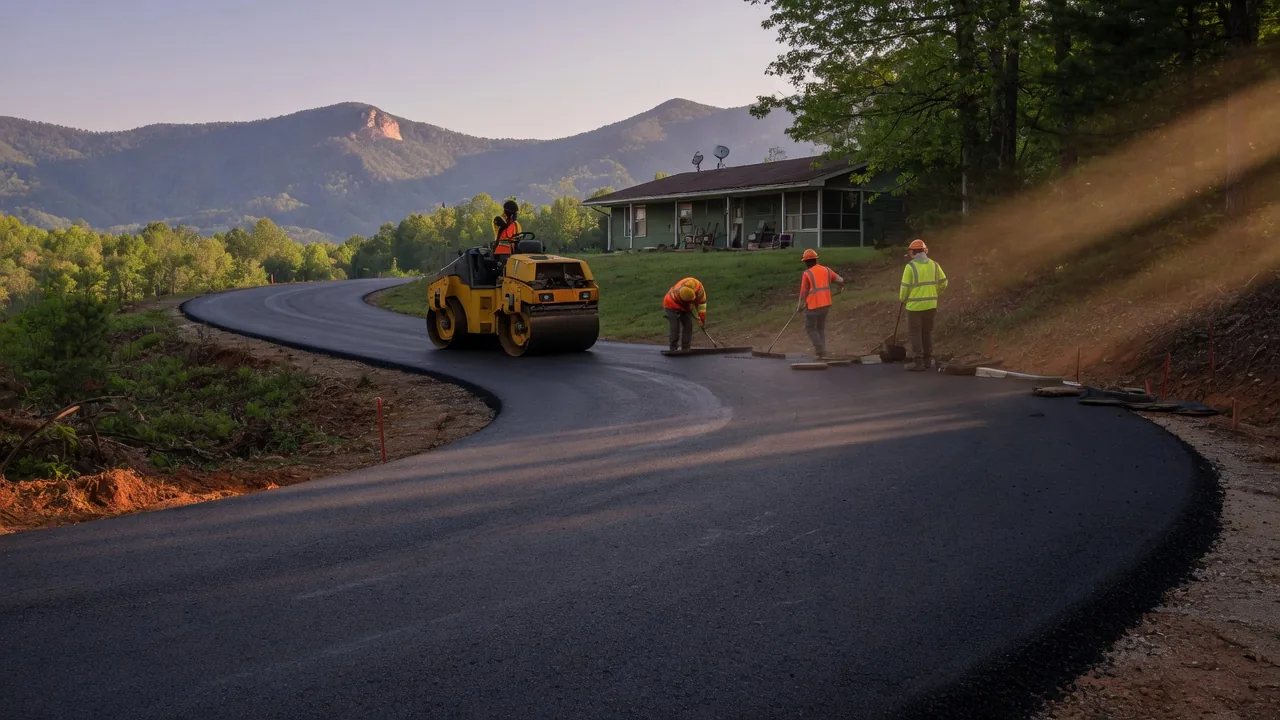
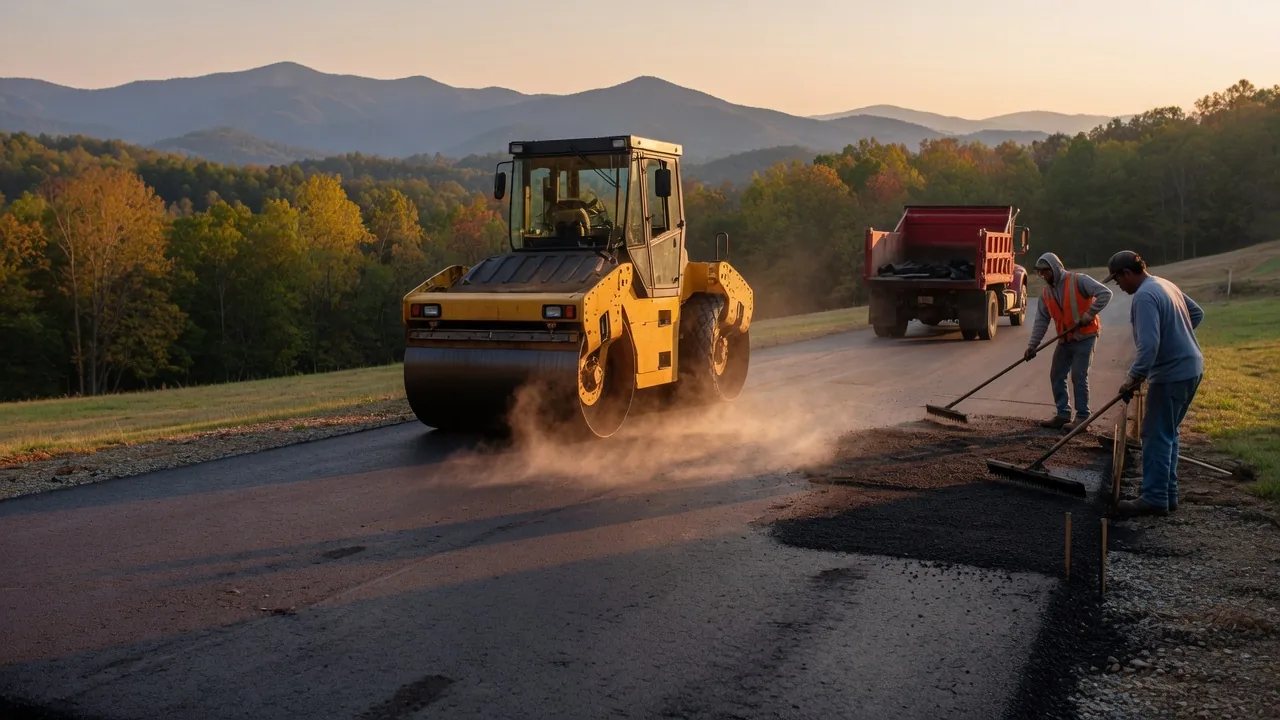
Fletcher sits along the I-26 corridor at the southern edge of the Asheville metro, where the French Broad River valley opens into rolling Henderson County terrain. Most residential driveways developed here over the past few decades were built on graded lots — a cut into the hillside to make a flat pad, with compacted fill under the driveway approach. That disturbed earth compacts unevenly, especially through western North Carolina's freeze-thaw cycle, and asphalt driveways installed on top of it will eventually expose the problem.
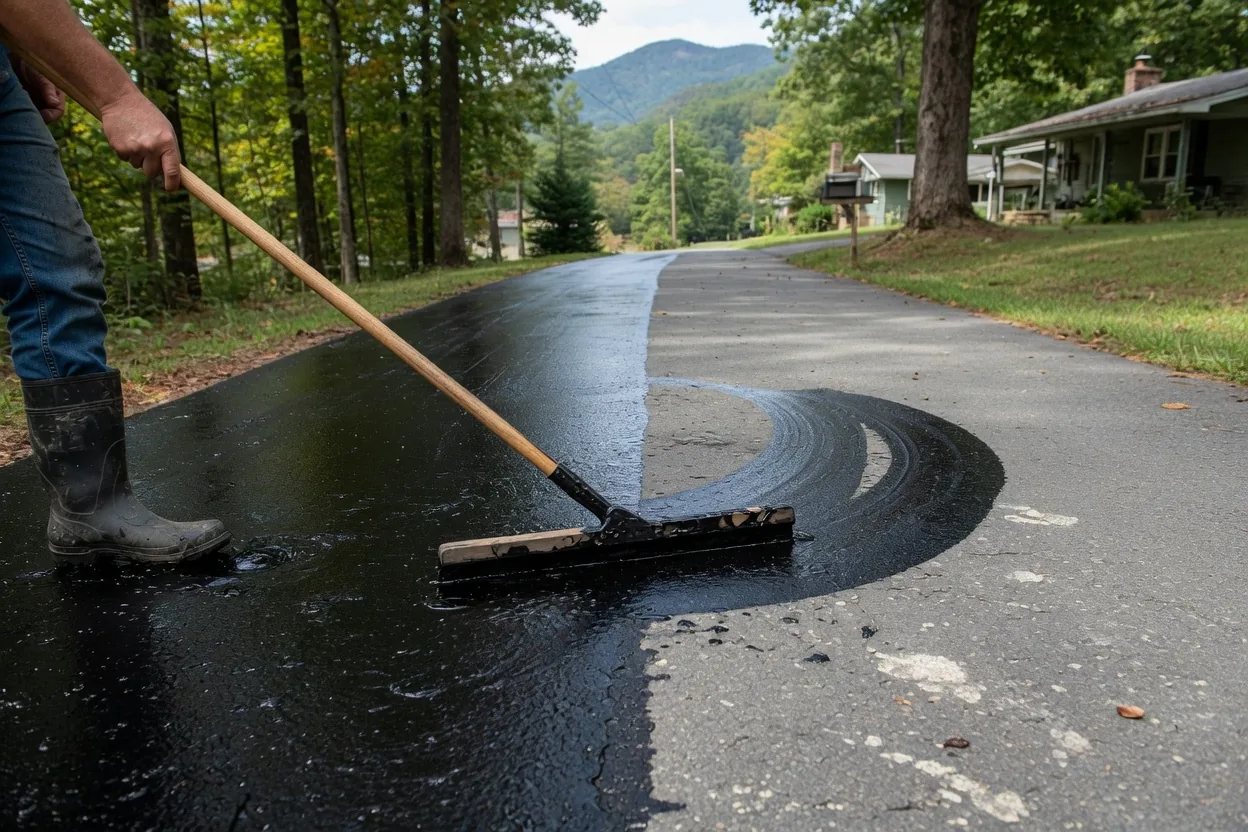
The practical result: a driveway in Fletcher that develops a crack near a slope transition is often revealing a subbase movement problem, not a surface wear problem. Patching that crack without addressing why the ground beneath it shifted is a cosmetic fix over a structural one. Two winters later, the patch opens again, slightly wider than before. Understanding the difference between a surface repair and a base-and-drainage repair is where every honest scope begins. The full driveway repair overview covers both types and when each applies.
This is what separates a Fletcher quote from a flatland quote: any contractor who prices the job without walking the slope, checking where water pools after rain, and evaluating the low-point edge condition has not actually scoped the job yet.
What the damage pattern tells you
Damage types common on Fletcher-area driveways follow a recognizable pattern. Longitudinal cracks, the straight breaks that run along the slope, almost always indicate thermal movement or subbase settlement along a fill boundary. Transverse cracks cutting across the driveway width near the top or bottom of a grade signal the same forces working perpendicular to the pour direction.
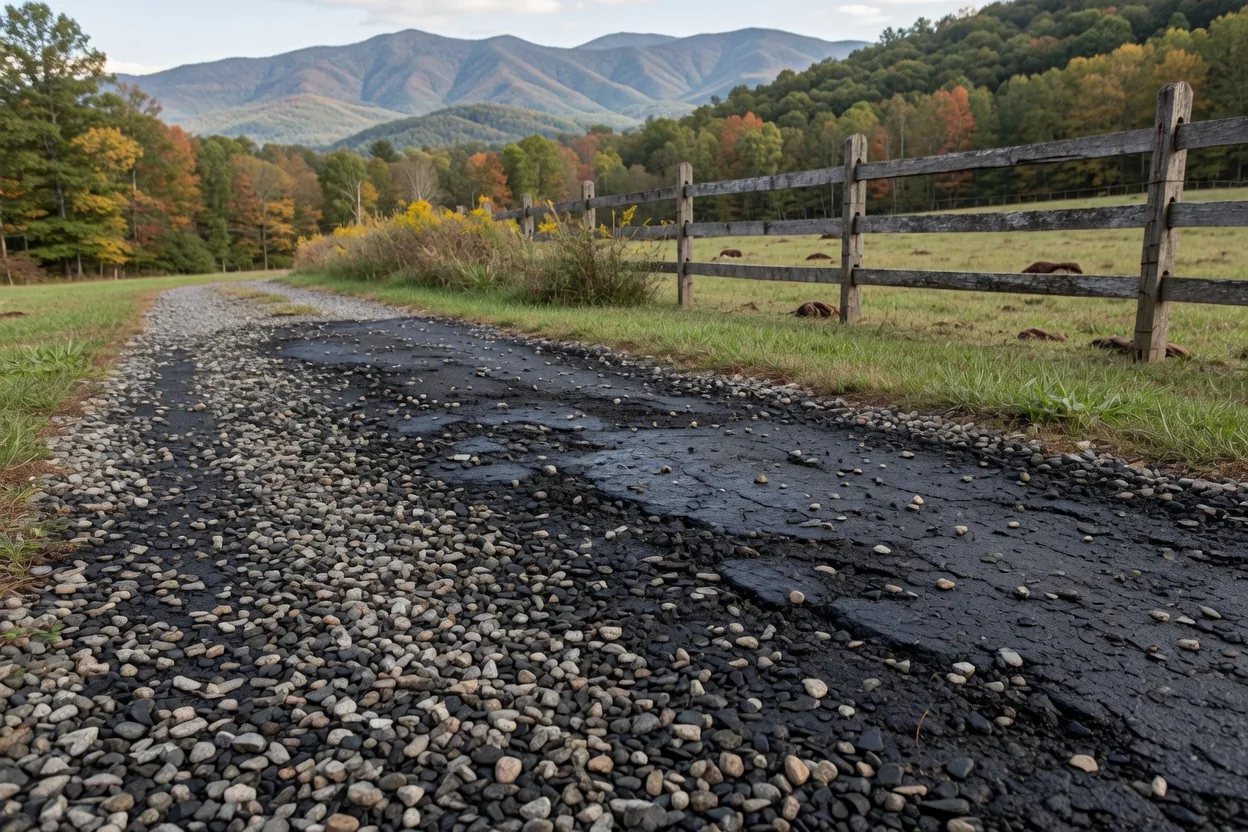
Alligator cracking, named for the interlocking block pattern it forms, is the warning sign that a section has lost structural integrity from below, typically because water has been sitting in the subbase. That pattern across more than a few square feet is not a patch candidate; it needs removal, base correction, and new asphalt. Surface sealer over alligator cracking is a few months' delay, not a repair.
Potholes that return in the same location each season are almost always a drainage symptom first. Water infiltrates through a crack, saturates the base, and traffic load punches through the weakened section. Fix the pothole without fixing the water path and the pothole comes back. Fix the drainage first, then the surface, and the repair holds.
Edge crumbling, where the outside inch or two breaks away, is common on Henderson County driveways with no curb or border restraint. The asphalt edge has no lateral support under repeated wheel load, and an edge repair without an edge treatment will repeat itself on the same schedule.
What repairs cost in the Fletcher area
The ranges below reflect typical residential work in Henderson County. Sloped access, drainage correction, or large-section replacement push jobs toward the upper end; small surface repairs on flat, structurally sound driveways land lower.
| Scope of Work | Typical Range | Notes |
|---|---|---|
| Crack sealing | $250–$550 | Hairline to half-inch cracks; no base work included |
| Pothole patching (1–3 spots) | $300–$650 | Hot-mix preferred; drainage check recommended first |
| Section removal and replacement | $700–$2,400 | Includes base correction; priced per section |
| Drainage correction with surface repair | $900–$3,200 | Common on cut-lot driveways; grading or pipe included |
| Full overlay (resurfacing) | $1,400–$4,500 | Existing base must be structurally sound; slope access included |
If your driveway connects to a state-maintained road, as many rural Henderson County properties do, any work that cuts or widens the apron at the road edge may require a driveway permit. Apply through NCDOT Connect before work begins. The NC Department of Transportation sets the threshold; most private interior driveways do not reach it, but corner lots and new apron cuts often do.
Precipitation and the freeze-thaw factor
Henderson County has 16 federal disaster declarations on record spanning 1978-2026, a number that reflects the region's long exposure to high-volume rainfall events. The county sits at the foot of the Blue Ridge Escarpment, where incoming weather systems drop significant moisture year-round across the French Broad and Mud Creek drainages. The National Weather Service issues flood advisories for Henderson County multiple times each year, and every significant rainfall event moves water across and into any paved surface not sealed against infiltration.
The freeze-thaw cycle compounds the moisture problem. Fletcher's elevation puts winter temperatures reliably below freezing on hard nights, and water that infiltrates a crack in the fall expands when it freezes, widening the crack by several times its original width through a single winter. A hairline crack sealed in October is a maintenance cost. That same crack left open through January is a structural problem by spring. Scheduling repairs before the first sustained freeze — typically late October to early November in the Fletcher area — is the highest-return maintenance decision a homeowner can make.
Getting the right crew for this terrain
Three questions worth asking any contractor before signing: whether they have worked on sloped driveways in Henderson County specifically; whether the written scope includes a drainage evaluation or addresses only the visible surface; and what they do when they find base failure under the section they are being paid to repair. The answer to the third question separates a repair crew from a patch crew.
For work that involves the road edge or right-of-way, verify permit status before scheduling. The Henderson County permits office handles local thresholds; state right-of-way work routes through NCDOT. A reputable contractor confirms this before the first shovel moves.
Get a written scope, not just a price. A written scope shows what is included — base work, drainage correction, edge treatment, haul-off — and lets you compare bids on equal terms. Any job in Fletcher's terrain that does not include a drainage observation is not a complete scope, regardless of how competitive the number looks.
Two public sources worth a look before any driveway work: the NC Department of Transportation sets the rules for driveways that connect to state-maintained roads, and the NC Department of Environmental Quality covers how runoff from paved and graded ground is supposed to be handled.