The permit question most Weaverville paving jobs reveal
Weaverville's residential streets and rural roads are a mix of town-maintained pavement and NCDOT-maintained right-of-way, and that distinction shapes what a driveway project requires before a paver arrives. Any driveway that connects to an NCDOT-maintained road — a large share of lots in North Buncombe — needs an approved driveway connection permit through NCDOT Connect before construction begins. That requirement is not discretionary, and contractors who skip it can leave homeowners holding liability for an unpermitted curb cut. Residential applications are generally straightforward, but approval takes time, so filing before you finalize a contractor is the right sequence. Weaverville's town street network is a smaller share of the overall roads in this corner of Buncombe County; if your driveway fronts on a road with a posted speed limit and no curb and gutter, it is almost certainly state-maintained.
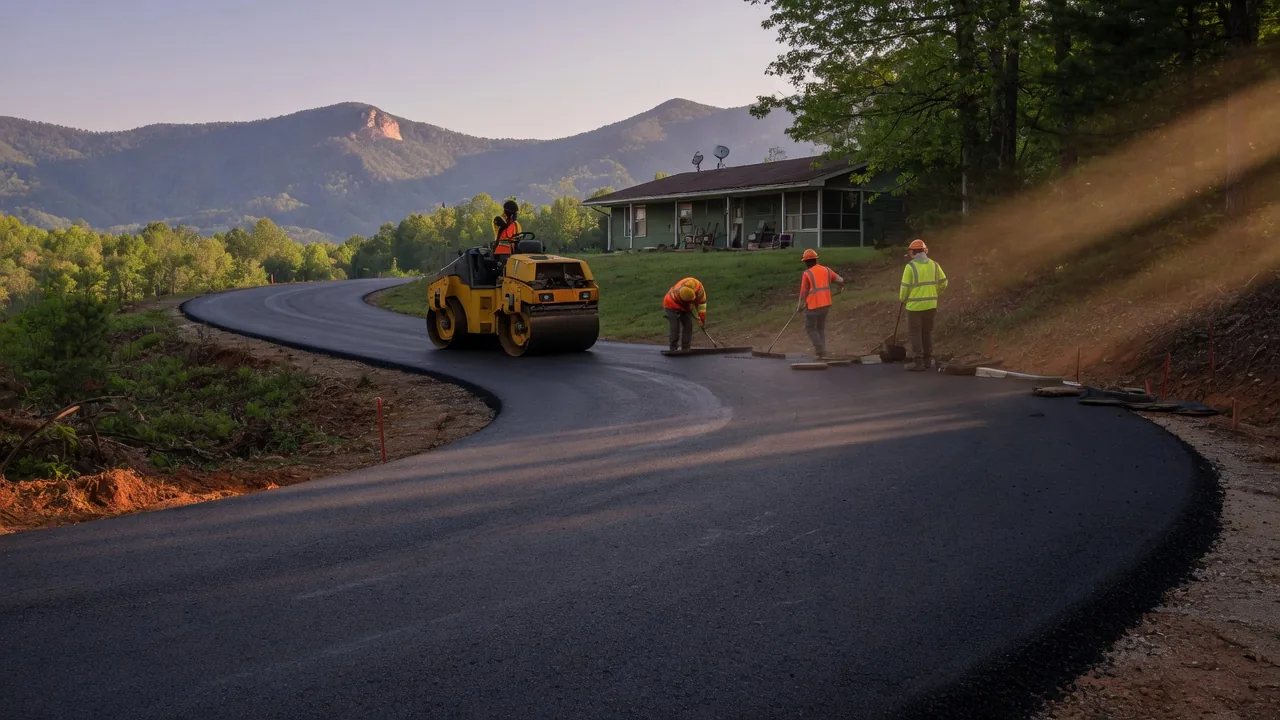
The other Weaverville-specific variable is grade. Lots along Reems Creek Road, New Stock Road, and the hillside subdivisions above town carry slopes that change both the base specification and the drainage design. A driveway that reads as five hundred square feet on paper becomes a different scope when it climbs twenty feet in elevation, requires cross-drain cuts, and exits onto a state road where NCDOT will review the proposed drainage plan as part of the permit. Any bid that omits drainage and permit line items on a sloped lot is not cheaper than the competition — it is missing pieces of the actual job. The full asphalt paving overview covers what a complete scope looks like on mountain terrain.
What mountain clay and freeze-thaw cycles do to a base
The soils underlying most of North Buncombe are predominantly mountain clay — heavy, moisture-retentive, and prone to heaving in freeze-thaw cycles. A flatland paving spec that calls for three inches of compacted stone base often needs to be four or five inches here, particularly on graded lots where water migrates laterally through the subgrade during wet winters. The failure mode is predictable: water infiltrates, saturates the base, the freeze cycle pops the asphalt mat from below, and what looked like good surface work starts cracking inside of three years.
Good base preparation costs more upfront, and every honest Weaverville paving quote should show it as a line item. The aggregate spec, compaction depth, and how the perimeter drains are all questions worth asking before work starts. A vague answer on any of those three points signals that the base step is being value-engineered out of the scope. The asphalt driveway cost guide walks through base work as a priced component so you can compare competing bids on equal terms.
Scope and price ranges for common Weaverville projects
Around Weaverville, new asphalt runs $4 to $8 per square foot installed, with a typical residential driveway landing between $3,500 and $12,000. Grade and base condition are the main movers within that range — a flat lot with sound existing base sits toward the bottom; a climbing hillside driveway that needs base work, cross-drain cuts, and an NCDOT-permitted apron sits toward the top. The table below maps common project types to realistic installed ranges.
| Project type | Typical size | Installed range | What pushes the quote up |
|---|---|---|---|
| Single-car driveway, flat lot | 400–600 sq ft | $1,600–$4,800 | Base repair, edge curbing |
| Single-car driveway, graded lot | 400–600 sq ft | $2,400–$6,000 | Cross-drain cuts, deeper base |
| Two-car driveway, flat lot | 700–900 sq ft | $2,800–$7,200 | NCDOT apron width, curbing |
| Two-car driveway, graded lot | 700–900 sq ft | $3,500–$9,000 | Drainage design, base rebuild |
| Parking pad or turnaround | 300–500 sq ft | $1,200–$4,000 | Retaining edge, drainage swale |
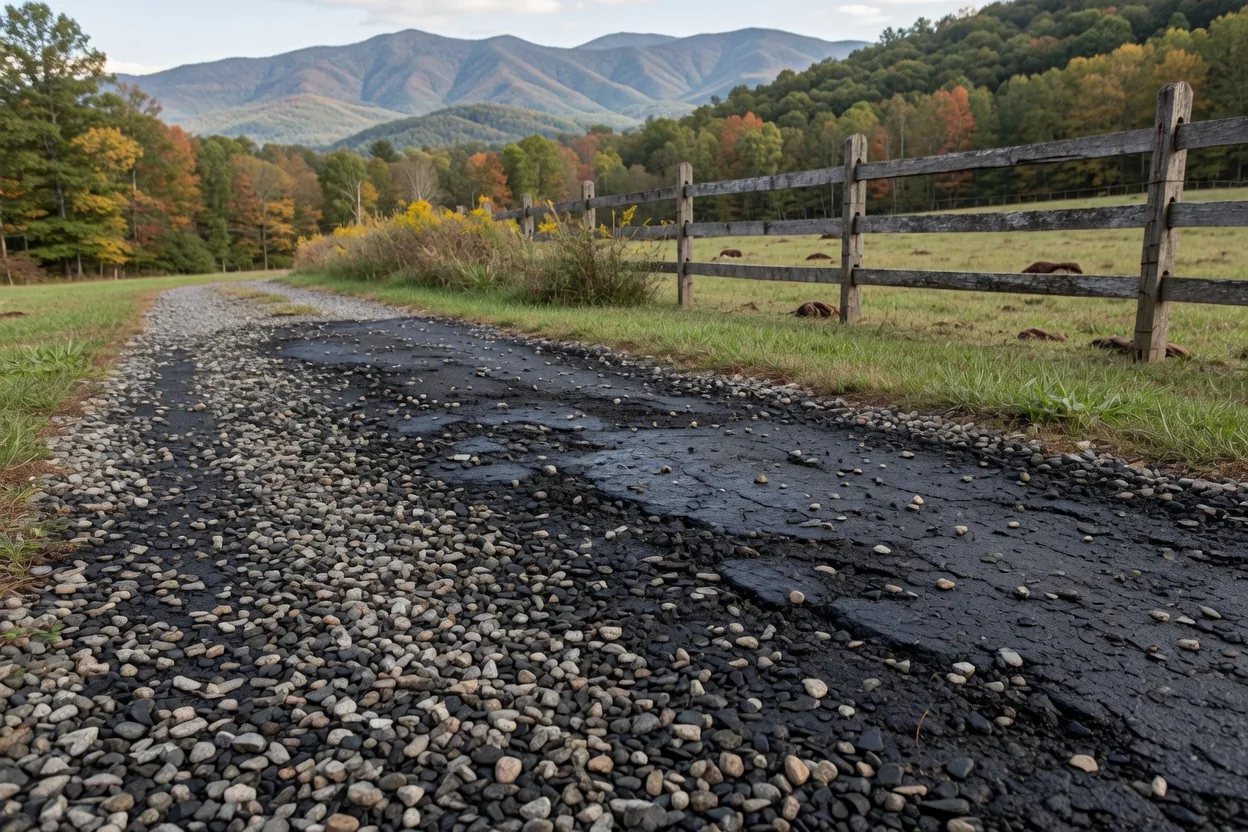
| Gravel-to-asphalt conversion | varies | $2,000–$12,000 | Gravel removal, full base grade |
Rain, runoff, and why drainage is a structural argument in Buncombe County
Buncombe County's position in the Southern Appalachians puts Weaverville in the path of orographic rainfall — storms that stall against the mountain ridgelines and drop concentrated precipitation over short windows. Federal disaster records show 19 declared events across this county over 1973-2026, most tied to flooding and severe weather. Each of those events tested every driveway in the valley the same way: surface water that cannot drain off the pavement moves through it, and water that moves through asphalt eventually moves the base underneath.
Crown grading — the slight peak down the center of a driveway that sheds water toward the edges — is the mechanism that keeps storm runoff from pooling and infiltrating. Perimeter grading that directs edge water away from the subgrade extends pavement life as reliably as asphalt thickness. The National Weather Service tracks precipitation patterns across Western North Carolina that make plain why drainage is a first-order design input for any paved surface in this region, not an afterthought to be negotiated out of the bid.
Reading bids and hiring well in North Buncombe
Three questions that separate contractors in this market: whether they have pulled NCDOT driveway permits on work in this area — which shows real familiarity with state-road frontage requirements — how they specify the base (aggregate type, compaction depth, and drainage all have concrete answers), and how they handle cross-drainage on graded driveways. A contractor without a clear plan on the third point has not worked many Buncombe County hillside lots.
The NC Department of Transportation publishes driveway connection standards that give homeowners a reference for what the apron and drainage work should include. Hardscape drainage also falls under standards overseen by the NC Department of Insurance's Engineering and Building Codes division. A scope that meets code is a floor, not a ceiling — on a sloped North Buncombe lot, the difference between pavement that holds for fifteen years and pavement that needs major work in five is almost always in the drainage design, not the asphalt brand. If your current approach is gravel, the gravel-to-asphalt guide covers what a full conversion scope should include and what to look for in competing bids.