Steep grades and storm runoff: what actually sets the price here
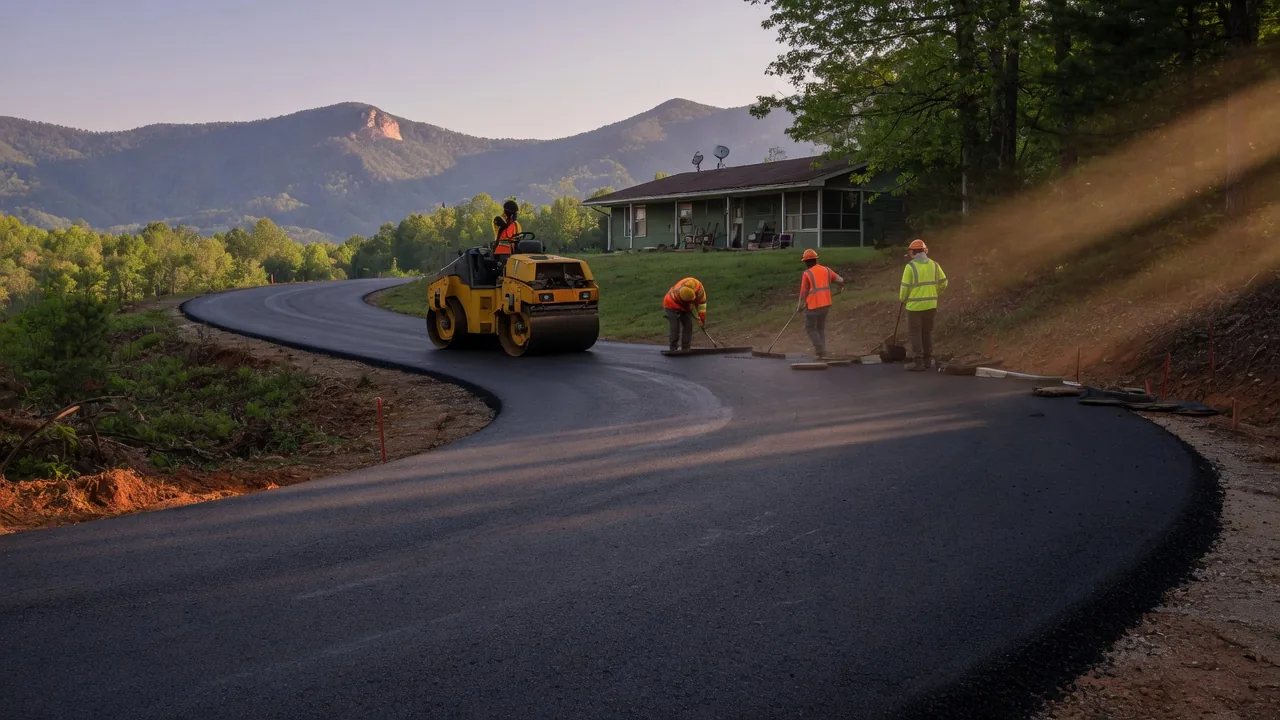
Buncombe County's residential lots are not the flat slabs you find in Charlotte or Greensboro. Asheville's neighborhoods climb ridgelines, fill in hollows, and angle sharply toward creek drainages — terrain that reshapes what an asphalt driveway job costs from the ground up. Layer on the county's rain exposure: 19 federal disaster declarations touch Buncombe County (1973-2026), the overwhelming majority of them storm and flood events. That precipitation record shows up in every paving conversation here: it is the reason base depth and edge drainage are not optional line items on a mountain lot.
Asheville's neighborhoods span a range that makes generalizing hazardous. The flatter stretches of West Asheville and the River Arts District look nothing like the steep residential roads climbing toward Town Mountain or the rural lots off Elk Mountain Scenic Highway. A house on a modest grade near a commercial corridor faces different base and drainage challenges than one on a private drive carved into a north-facing slope. Understanding which category your property falls into is the first step to understanding where in the table your job lands.
The table below reflects honest working ranges for residential jobs in Buncombe County. A contractor who quotes you by phone, before walking your grade, is pricing a different driveway than the one on your property.
| Scope of work | Typical Buncombe range | What drives it |
|---|---|---|
| Standard flat driveway (under 1,500 sq ft) | $3,500 – $6,000 | straightforward prep, minimal grading required |
| Moderate slope or longer run (1,500–2,500 sq ft) | $5,500 – $9,500 | compaction lifts, edge drainage, added base material |
| Steep hillside driveway with full grading | $8,000 – $12,000 | cut-and-fill work, deep base, surface pitch engineering |
| Culvert at road entry (add-on line item) | $800 – $2,500 | pipe diameter, headwall material, NCDOT spec |
Those ranges work out to roughly $4 to $8 per square foot installed. The spread is wide because the lots are wide — a flat driveway in a valley neighborhood and a switchback run up a ridge face are priced by the same trade but built almost nothing alike.
Why base depth is not a standard answer on a mountain lot
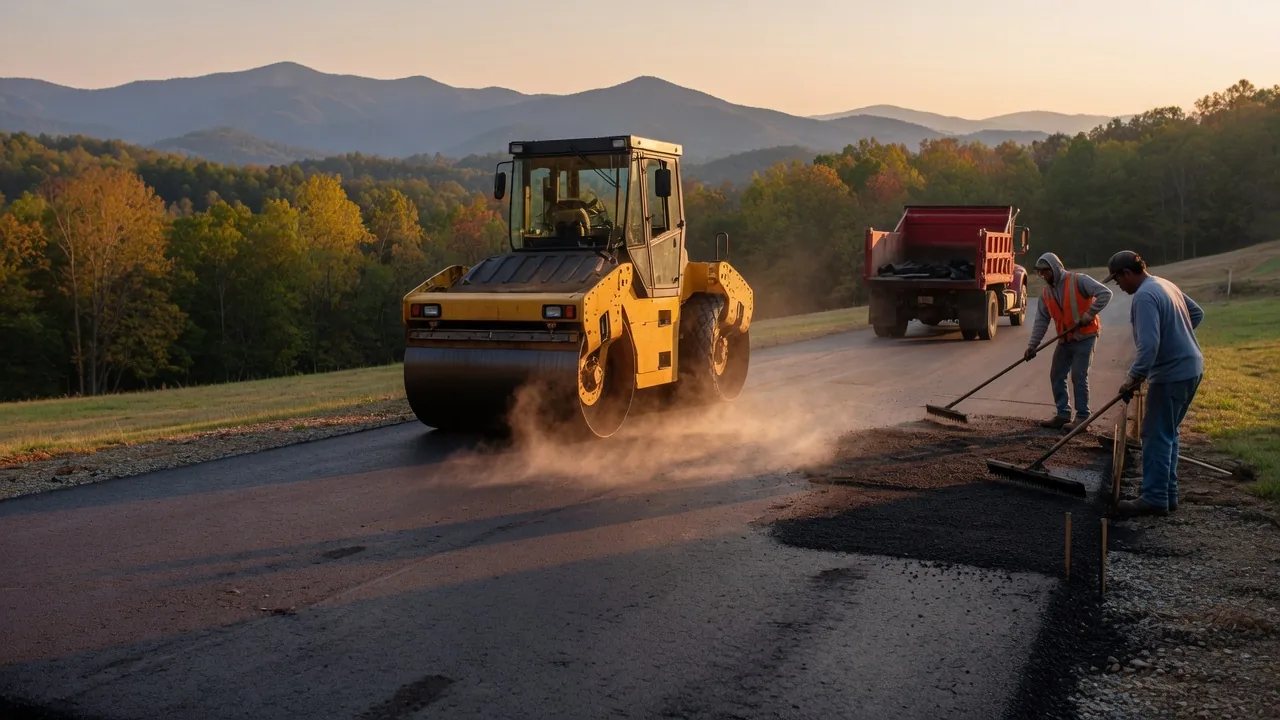
Asphalt is only as stable as what is under it, and in Buncombe County what is under it varies more than contractors accustomed to Piedmont work expect. Ridge lots hit rock at unpredictable depths — sometimes shallow enough to require a thin base and specialized equipment, sometimes deep enough that compaction requires several separate lifts. Hollow lots carry clay that swells with moisture through winter and shrinks under summer heat, working at every edge and low point that was not properly prepared.
A flat suburban driveway outside the mountains can often do well with a standard four-inch compacted gravel base. A Western North Carolina hillside driveway carrying regular vehicle traffic through freeze-thaw cycles typically needs six to eight inches of base material, applied and compacted in lifts, with attention paid to how water exits the edges after a heavy rain. When a paver's quote does not specify base thickness or compaction method, that is the question to ask before any number makes sense.
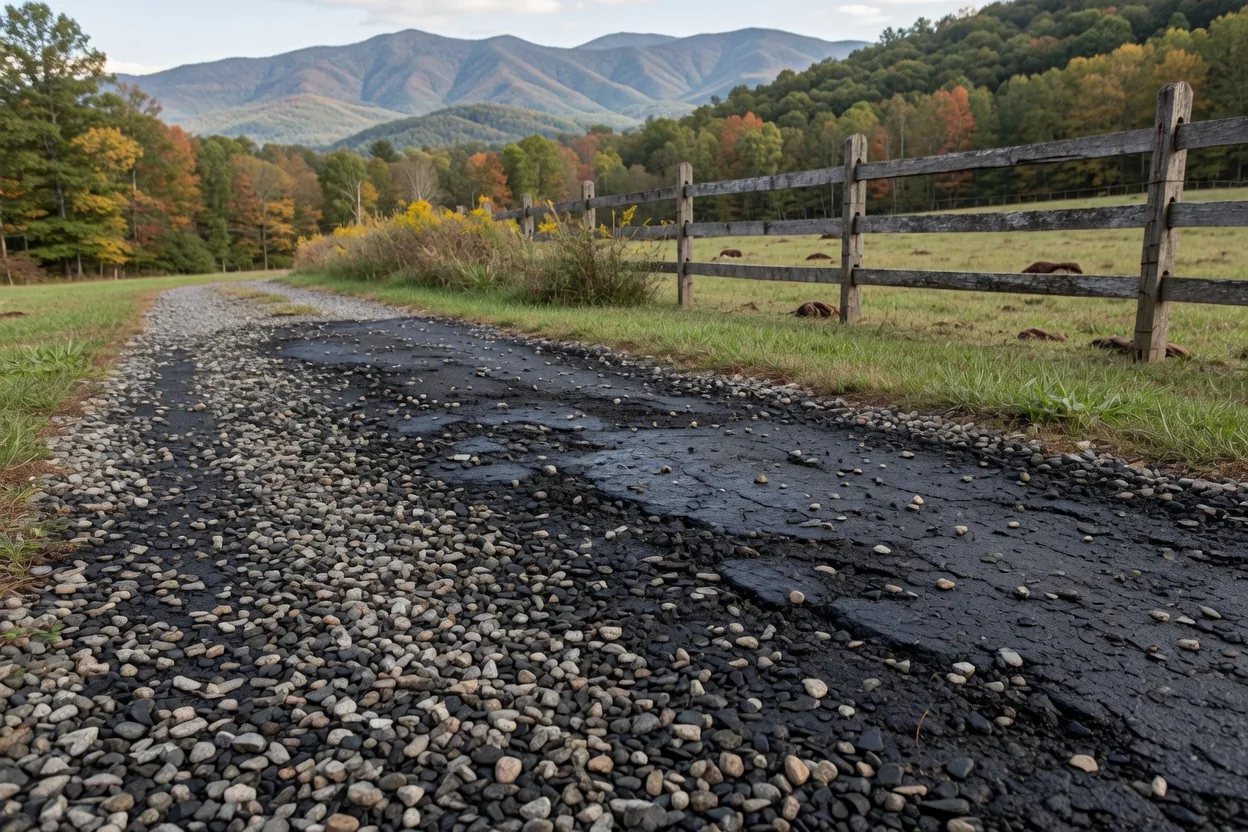
This is also where the comparison with gravel becomes concrete. Loose stone has a lower upfront cost, but on a steep WNC grade it shifts, ruts, and washes in ways that a paved surface resists. Our guide to paving over a gravel driveway covers what that transition actually costs and when the long-term math tips toward asphalt.
Permits, road connections, and what NCDOT requires
Two permit questions come up on nearly every residential driveway job in Buncombe County, and they are not the same question.
If your driveway connects to a state-maintained road — and a substantial portion of Buncombe County properties do — a driveway permit from NCDOT is required before any paving begins. Applications go through NCDOT Connect, and the permit governs sight-line distance, culvert sizing, and the driveway apron dimensions where your surface meets the road. NCDOT sets those standards statewide; the district office handles the site-specific review. Skipping this step does not make the requirement disappear — it means you are responsible for bringing the work up to spec when the connection is flagged, which typically means tearing out what was just installed.
Properties inside Asheville city limits carry a second layer: the City of Asheville may require a permit depending on scope, and especially where an existing curb cut is being modified or a new access point added. The city's development services office handles those reviews. If a contractor reaches the quote stage without raising the permit question, raise it yourself — that conversation will tell you a great deal about how they work.
Drainage is core scope on a Buncombe County hillside, not an upgrade
A hillside driveway in this county is not just a paved surface; it is also the lowest point on a slope that collects runoff from a wide area above it. Every Asheville neighborhood that climbs a ridge demonstrates this during a sustained rain: water flows across the drive, erodes the edges, and concentrates at the road entry. A properly designed driveway addresses that by building cross-pitch into the surface to shed water toward the edges, adding a swale or ditch on the uphill side to intercept flow before it crosses the paved area, and sizing any culvert at the road entry to pass the drainage load without backing up.
What this means when you are reading a bid: a line item for drainage work on a sloped lot is not padding. It is the difference between a driveway that holds its shape for fifteen years and one that starts cracking at the edges by year three. Ask each bidder to describe how water leaves your property after a hard rain. If the answer focuses on asphalt thickness and skips the water story entirely, you have a useful data point about how that crew approaches site work.
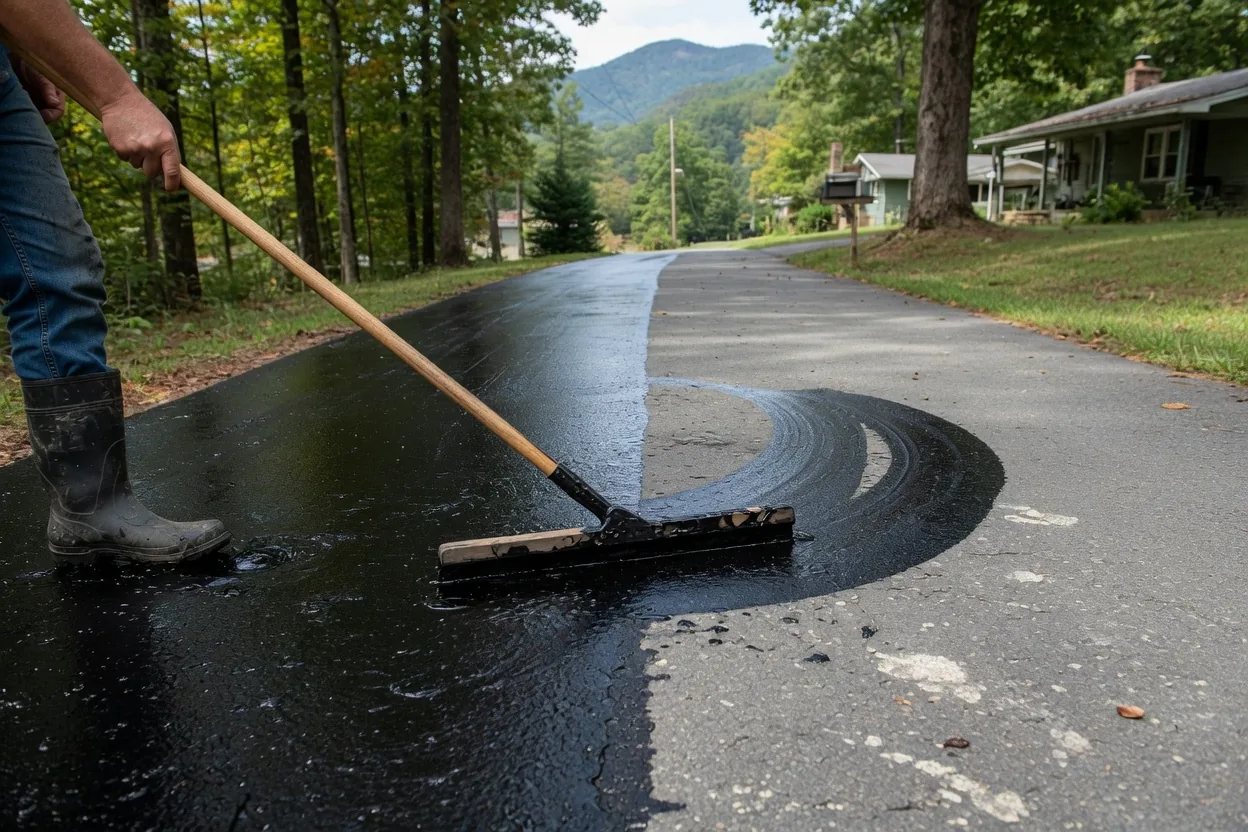
Keeping the surface in good shape after installation matters here too. WNC's freeze-thaw cycle runs from late fall through early spring, and small cracks that go unsealed become larger ones by the following spring thaw. Most contractors recommend a first sealcoat two to three years after installation — once the asphalt has cured fully — then on a three-to-five-year cycle after that. On a south-facing slope with high sun exposure, UV degradation runs faster and the schedule shortens. That maintenance cost is real, but it is modest compared to resurfacing a drive that was never properly sealed. The asphalt paving overview covers the maintenance schedule Top Lift recommends for mountain-climate driveways in this region.
Reading a quote before you sign
Three practices protect you when comparing bids on a hillside driveway:
- Ask for a line-item breakdown. A quote that separates grading, base material, asphalt tonnage, and any drainage or culvert work is one you can compare across bidders. A single lump sum hides every assumption about your lot.
- Confirm the base spec in writing. Ask what base thickness the contractor is planning and how they compact it. If they cannot tell you the thickness before they start, they are not pricing your specific grade.
- Run the per-square-foot check. Divide the total by your driveway's area. If the result lands outside $4 to $8, ask for the explanation. Sometimes there is a legitimate reason — an unusually deep base requirement, a culvert that needs a headwall — and how a contractor explains it is as informative as the number.
Before you settle on a surface material, the asphalt versus concrete comparison lays out how each performs through Buncombe County's freeze-thaw cycles and on sloped surfaces. Concrete's higher upfront cost sometimes pencils out differently on a mountain lot; that page gives you the full picture.