Mountain grades change who should be doing this work
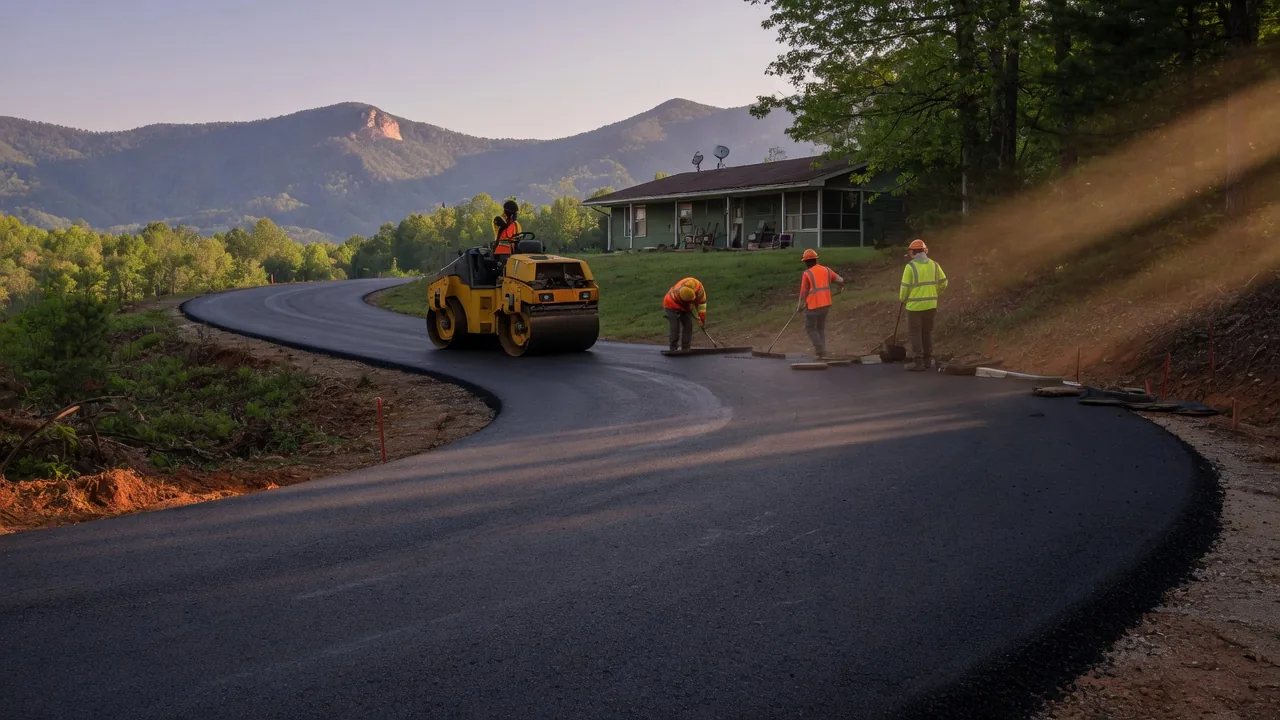
Asheville sits at roughly 2,100 feet, and the surrounding Buncombe County neighborhoods climb well beyond that. Driveways in West Asheville, Kenilworth, and the ridge roads above downtown frequently run at grades where surface water management, freeze-thaw heave, and sub-base compaction are structural concerns, not cosmetic ones. Asphalt paving on those slopes requires engineered drainage to survive the region's rainfall — Buncombe County has recorded 19 federal disaster declarations over 1973-2026, a large portion tied to flooding and storm runoff. That history is why the licensing question carries more weight here than on a flat coastal lot: the technical demands are higher, and the paper trail of who did the work — under what license and permit — becomes your protection when water damage is later disputed by an insurer or a buyer. A steep driveway with no encroachment permit on file and no licensed contractor on record is a negotiating liability the moment you list the house.
The $40,000 threshold — what the licensing law actually says
North Carolina's contractor licensing framework is administered by the NC Licensing Board for General Contractors. The statewide rule for paving work on private property:
| Scope of Work | License or Permit Required? |
|---|---|
| Driveway or parking lot paving, under $40,000 | No state GC license required — local permits may still apply |
| Driveway or parking lot paving, $40,000 or more | Licensed General Contractor required |
| Any work connecting to an NCDOT-maintained road | NCDOT encroachment permit required, regardless of project cost |
| Paving in Asheville city right-of-way | City encroachment and ROW permit required |
| Resurfacing or paving on a state-maintained road | NCDOT contractor prequalification required |
| Sealcoating or crack filling only | No state license required in most cases |
The $40,000 line is the floor, not a ceiling on what documentation applies. In Buncombe County, a steep driveway that requires significant grading, retaining walls, or French drain installation alongside the asphalt can approach or exceed that number more easily than a flat-lot job of equivalent square footage would in a Piedmont county. Getting a written itemized estimate before assuming you're safely below the threshold is not optional — it's the only way to know which rules govern your project.
Public roads run on a different track — NCDOT prequalification
State GC licensing and NCDOT contractor prequalification are two separate systems, and confusing them is a common mistake. Any contractor resurfacing, patching, or paving on a road in the NCDOT-maintained system must complete NCDOT's prequalification process — a review of financial capacity, equipment inventory, and documented experience that runs independently of the GC license. Buncombe County has a high proportion of roads on the state system, including many of the mountain routes that connect hillside neighborhoods to US 19/23, I-26, and the Blue Ridge Parkway corridor. A contractor bidding on any public paving project in this region needs current NCDOT prequalification; the GC license alone is not sufficient.
For homeowners hiring for private driveways or parking lots, NCDOT prequalification is not your concern — that's for public-road bidding. Your relevant check is the GC license for jobs over $40,000, which you can verify in under a minute through the board's public lookup at nclbgc.org. If a contractor declines to provide a license number on a large job, treat that as the answer.
Driveway connections to state and city roads
Whenever a new or substantially modified driveway apron connects to a state-maintained road, an encroachment permit is required through NCDOT Connect — regardless of whether the driveway itself crosses the $40,000 licensing threshold. The permit process reviews sight-distance requirements, apron dimensions, and drainage design. Those drainage standards carry particular weight in Buncombe County: on mountain grades, an improperly pitched apron can redirect runoff onto the road shoulder, contributing to edge failures on the road itself. NCDOT inspectors in mountain districts see that failure mode regularly and review drainage plans accordingly.
For driveways connecting to streets within the City of Asheville's maintained network, the parallel process runs through the City of Asheville's encroachment and right-of-way permit office. The two systems — NCDOT and city — are separate applications with separate review timelines. If you're unsure whether your road is city-maintained or state-maintained, both the NCDOT road inventory and the city's online GIS portal let you check by street address before you apply anywhere. See the full NC driveway permit requirements page for the complete application walkthrough, required documents, and typical review timelines by jurisdiction.
What unpermitted or unlicensed paving work actually costs later
Three places undocumented asphalt work resurfaces in Buncombe County: resale, where a buyer's inspector or real-estate attorney flags a recent driveway with no encroachment permit record and the negotiation reopens; insurance claims, where storm-related slope or drainage damage adjacent to undocumented paving invites coverage disputes — a real risk in a county with 19 federal disaster declarations over 1973-2026; and NCDOT right-of-way enforcement, where an unpermitted connection to a state road can require removal and full restoration at the property owner's expense, not the contractor's.
The permit and license record is also your practical leverage against a contractor who cuts corners — a failed inspection is a redo on their dime. For a realistic budget picture before work begins, the asphalt driveway cost guide covers regional price bands: standard residential paving in western NC typically runs in the range of $3–$7 per square foot, depending on grade severity, required drainage work, and base depth. The range widens on steep Buncombe County lots because the sub-base and drainage work — not the asphalt itself — is where mountain paving jobs get expensive. Permit fees are a small fraction of that total. The cost of unpermitted work discovered during due diligence is not.
What a legitimate contractor will have in order
A licensed, compliant paving contractor working in Buncombe County should be able to hand you, without hesitation: their NC GC license number (for jobs at or approaching $40,000), a copy of the NCDOT encroachment permit application or approval if the driveway connects to a state road, proof of general liability insurance, and a written scope that itemizes drainage, base preparation, and asphalt depth separately from the surface finish. That last point matters on mountain terrain: proposals that lump everything into a single square-foot number make it impossible to verify whether the base spec meets the grade requirements. Contractors doing this work regularly in the Asheville area know the mountain drainage requirements and will write them into the scope. Those who don't will not, and you'll see the difference at the first heavy rain after the NCDOT inspection closes out.