What steep grades change about a Black Mountain paving job
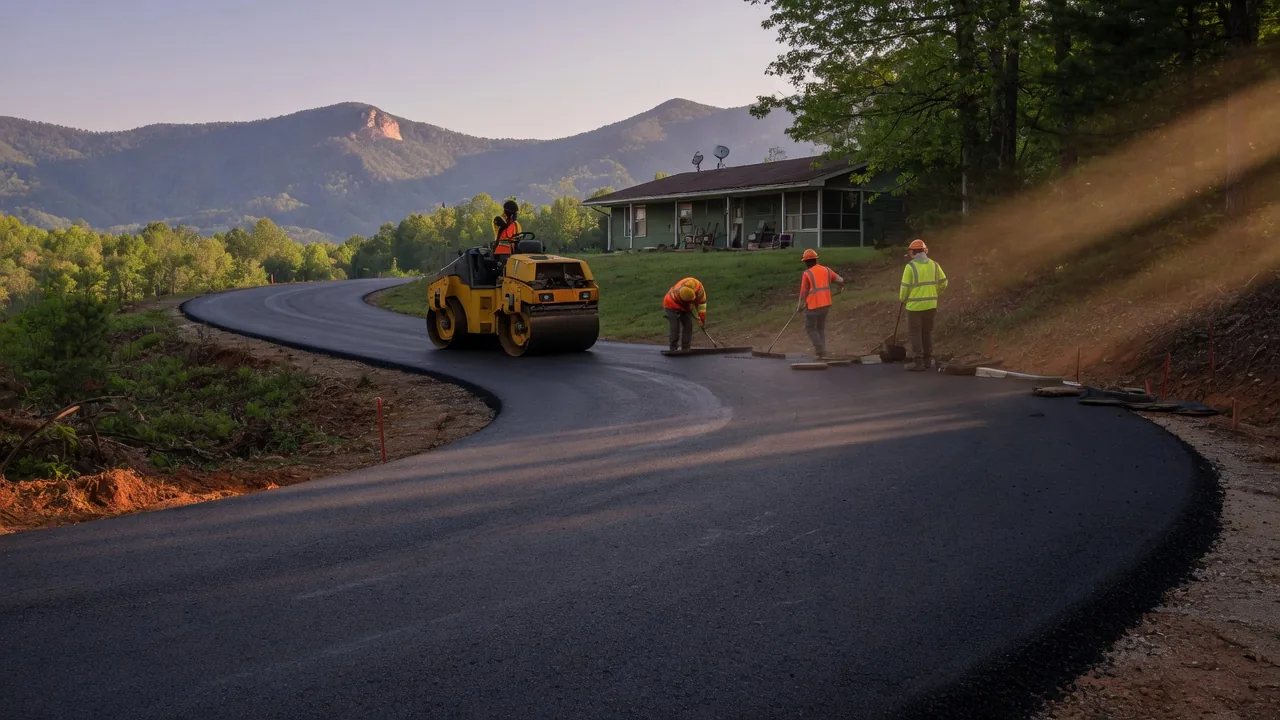
Black Mountain sits at the eastern edge of Buncombe County, tucked against the Blue Ridge wall where the Swannanoa Valley narrows and the lots get steep. A driveway here is not the gentle run you find on county flatland — it climbs, bends, or traverses a hillside, and every one of those conditions changes what a paving job actually requires. A crew quoting by the square foot without walking the grade is skipping the variables that determine whether the job holds for fifteen years or three.
On a significant slope, asphalt needs deeper aggregate base to resist the creep that summer heat causes on an inclined mat. The downhill edge needs positive restraint — cut into the bank or tied to a concrete border — or the mat lifts and separates within a few seasons. Water needs a path other than straight down the face of the drive: a crown-cut cross slope, a central channel, or edge drains set during base prep are the standard solutions. None of those items appear in a quote that starts and ends with a square-footage calculation.
For a full breakdown of what drives the final number on a mountain lot, the asphalt driveway cost page covers each line item with realistic ranges.
What jobs in this area typically cost
The county-wide $4–$8 per square foot installed range holds here, but Black Mountain's topography means most residential jobs land in the middle to upper half of that band. A straightforward driveway on a gentle grade runs $3,500–$6,500; add meaningful slope, extended base material, or drainage work and the total can reach $10,000–$12,000 for larger or steeper installations.
| Scope | Typical Range |
|---|---|
| Crack seal and patch | $300 – $900 |
| Reseal existing surface | $400 – $800 |
| New driveway, gentle grade (600–1,200 sq ft) | $3,500 – $7,500 |
| New driveway, steep or long mountain grade | $6,000 – $12,000 |
| Gravel-to-asphalt conversion | $4,500 – $11,000 |
| Drainage work (channel, French drain) | $800 – $2,500 |
Every quote should specify base depth, compaction method, drainage direction, and whether the road connection requires an NCDOT permit. A quote that omits those items is not lean — it is incomplete. The full services overview explains what a complete project scope covers.
Storm history and what it means for base work
Buncombe County's federal disaster record bears directly on asphalt work in the Swannanoa Valley. The county has seen 19 federally declared disaster events spanning 1973-2026, the majority driven by storm and flood conditions. Black Mountain's position in the valley makes it a consistent recipient of those events — heavy rain systems funnel through the mountain gap here, and runoff volumes regularly exceed what older drainage systems were built to handle.
The practical consequence for asphalt is base failure that arrives slowly: water infiltrates a poorly drained base, softens the subgrade, and eventually shows up as rutting, edge cracking, or surface depression. The fix is not thicker asphalt — it is drainage designed into the base preparation before the first lift of mix goes down. The National Weather Service precipitation records for this station document the rainfall patterns that make drainage a first-tier design requirement here, not an optional add-on.
State road connections and the permit you need first
Driveways that connect to a state-maintained road in North Carolina require a driveway permit, and most roads in and around Black Mountain fall under NCDOT jurisdiction. The permit process through NCDOT Connect sets minimum standards for sight distance, apron grade, and pipe sizing at the road connection — standards that directly affect how the paving crew grades the apron and sets the edge treatment. Beginning paving work on a state-road connection without that permit is not a shortcut; the NC Department of Transportation has authority to require corrective work or removal at the property owner's expense.
For connections to town-maintained or private roads, the permit rules differ. Confirm with the Town of Black Mountain which jurisdiction governs your street before scoping begins. Your contractor should ask about permit status during the site walk — if that question does not come up before the bid is finalized, raise it yourself.
Converting a gravel driveway to asphalt in Black Mountain
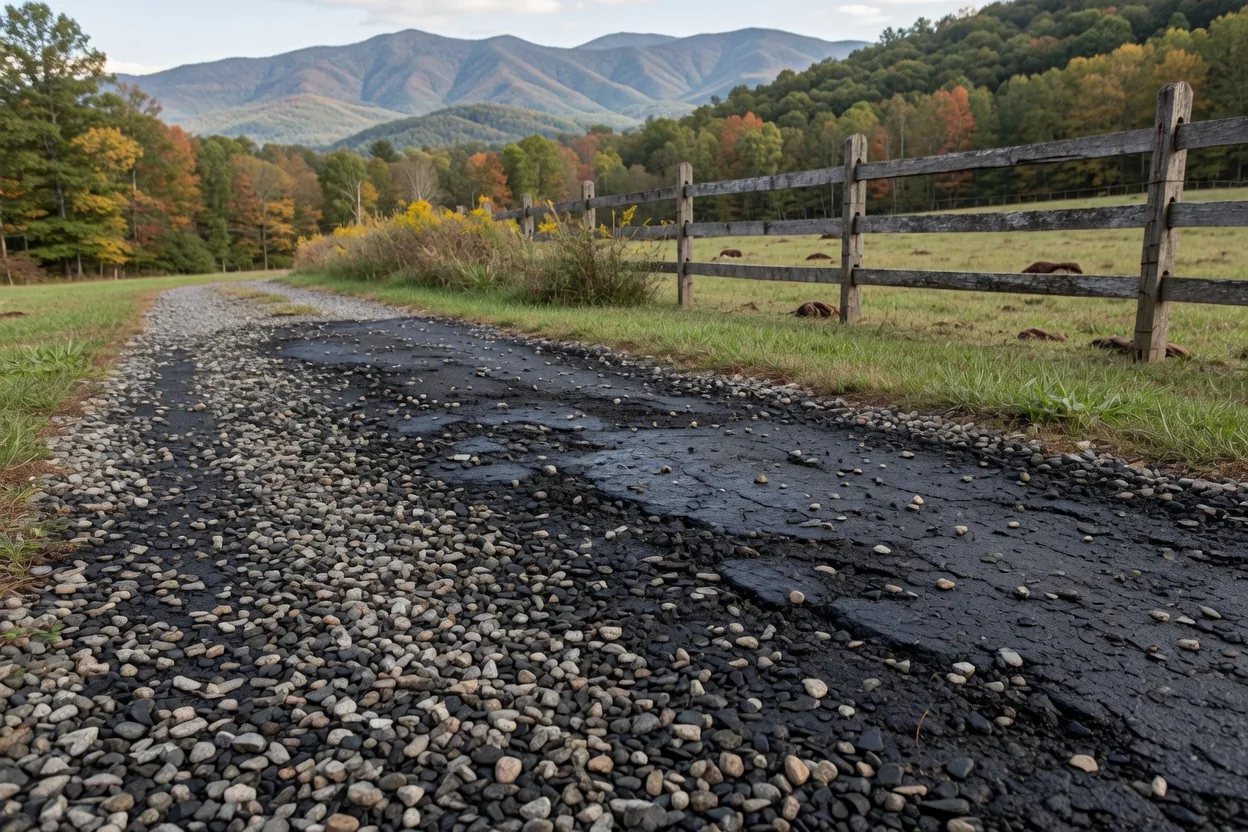
Black Mountain has a significant number of properties running gravel — older homes on rural routes through the valley, mountain builds where asphalt was deferred as a first-phase road, parcels where a long drive made paving feel optional. The conversion question is common here, and the answer depends heavily on what the existing base looks like.
A gravel driveway that has been maintained, drains cleanly, and holds its crown is a workable foundation for asphalt. One that holds standing water, has settled unevenly, or sits over clay that drains poorly needs base remediation before paving — otherwise the drainage problem gets sealed under a $6,000 or $8,000 surface. On steep grades this is the step that matters most: the contour set during base prep determines how water moves across the finished pavement for the life of the job. The gravel-to-asphalt conversion guide covers what to expect from this process on mountain lots, including how to assess whether your existing base is pave-ready.
Reading a Black Mountain paving bid
Three questions separate a complete bid from a low one in this market. Does the quote specify base depth and material — mountain lots typically need six to eight inches of compacted aggregate, and a quote that says only "base prep included" is not a specification? Does it address drainage — where surface runoff goes and whether any subsurface water path runs under the footprint? Does the apron treatment account for NCDOT permit requirements if the road connection is state-maintained?
A bid that answers all three clearly is worth more than one that leaves them open, even when the dollar figure reads higher. The least expensive quote on a steep lot usually skipped grade, drainage, or base spec — and those omissions show up within a few years. When you are ready to get a concrete scope, the asphalt paving services page outlines what a thorough project evaluation covers.