Where the grade earns its keep
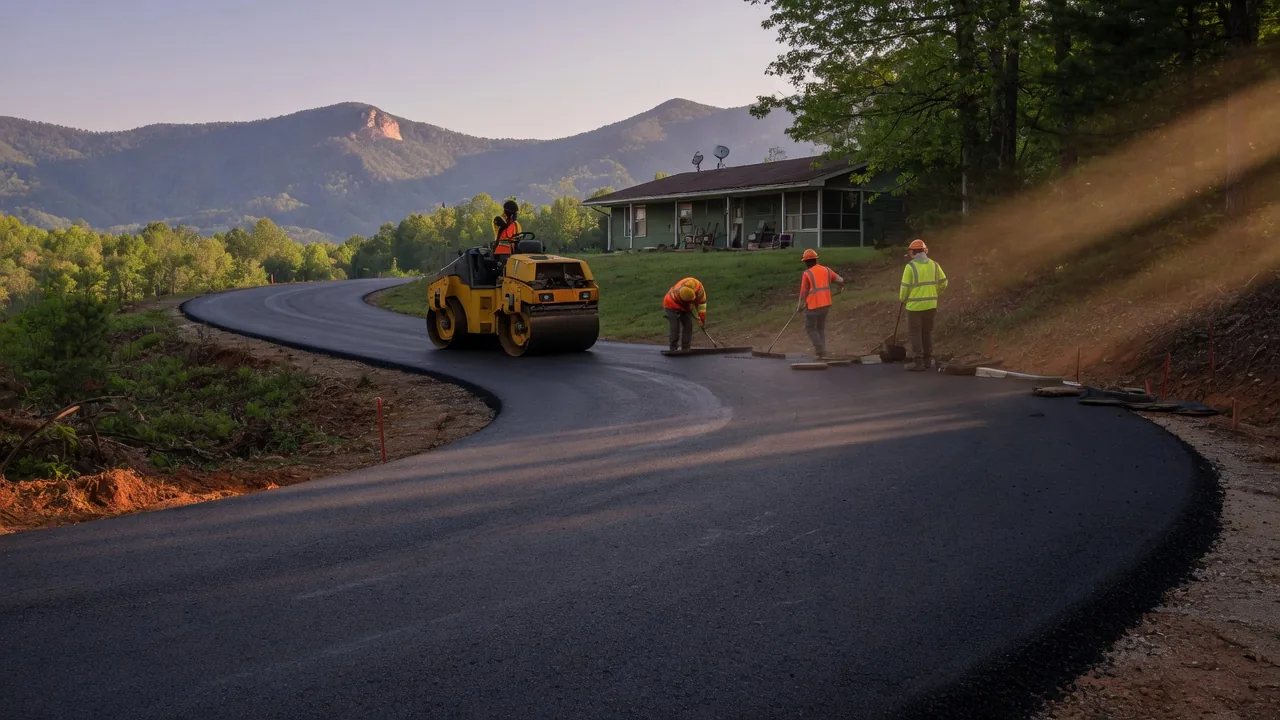
Black Mountain sits at the eastern edge of Buncombe County, where the Blue Ridge begins climbing in earnest toward the high crest. Most residential driveways here aren't the flat, slab-to-garage runs common in the Piedmont — they're cut-slope approaches descending thirty to eighty feet from the road, long rural lanes that shed elevation before leveling at the garage, ridge-line entries carved into terrain that makes every paving job a grading job first.
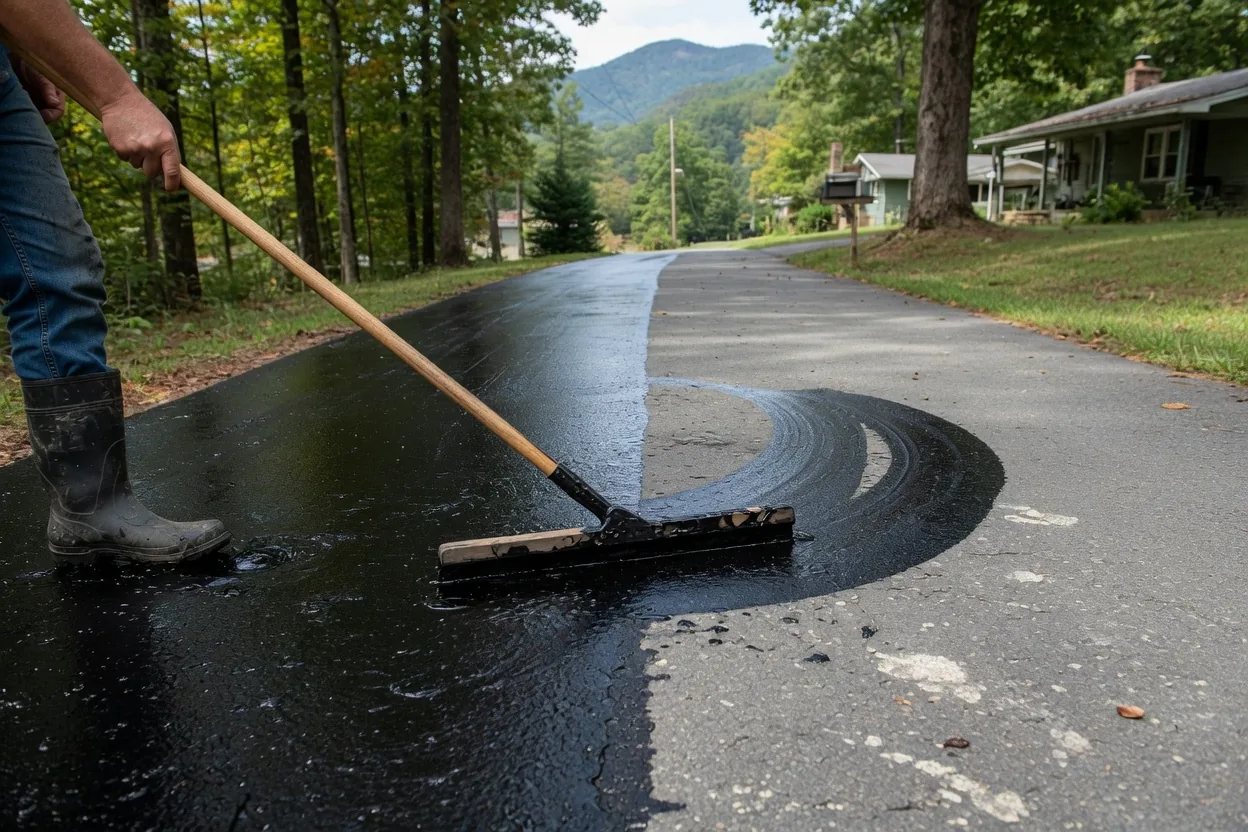
That terrain is the decisive factor in surface selection, and it's what makes tar and chip a particularly strong match for this market. The embedded stone aggregate grips when plain asphalt would offer nothing — on a wet November approach, in the freeze-thaw shoulder season that western North Carolina sees almost every year, on a sun-baked south-facing bank in July when blacktop softens and ruts under tire pressure. Tar and chip resists both the summer heat failure and the winter traction problem that plague asphalt on grades.
One honest limitation that follows from the same grade: better base prep is not optional here. A drainage problem under a flat driveway is a nuisance; under a slope, water tunnels downhill beneath the surface and lifts the whole installation from the inside. If you're still evaluating surface options, the tar and chip overview lays out where this material performs and where it doesn't.
What jobs cost around Black Mountain
Most driveways in this area run between $3.50 and $6.50 per square foot installed, which puts a standard 1,000-square-foot approach at roughly $3,500 to $6,500. Grade and base condition are the two variables that push a job toward the top of that range. The full cost breakdown page has line-item ranges for materials, prep, and drainage; the table below reflects how Black Mountain terrain typically moves those numbers.
| Job scope | Typical range | What drives the number |
|---|---|---|
| Short or flat approach (~500 sq ft) | $1,750 – $3,250 | Base condition, site access |
| Standard driveway (~1,000 sq ft) | $3,500 – $6,500 | Grade, stone choice, drainage |
| Long or steep driveway (~1,500 sq ft) | $5,250 – $9,750 | Regrading, base build, drainage |
| Base rebuild add-on (per project) | $800 – $2,500 | Slope severity, soil condition |
Stone selection moves a job within the per-square-foot range — economy aggregate pushes toward $3.50, a premium-chip specification toward $6.50. Several other line items that appear on steep-lot quotes deserve scrutiny rather than suspicion. Surface-water grading to redirect runoff away from the driveway edge is often legitimate: water that runs against a paved surface long enough will undermine the base. The right question to ask a contractor isn't "why is this here" but "where does this water go once it leaves the pipe" — a confident crew can show you the outfall location on the site.
Permits, NCDOT, and the road connection
Black Mountain and the rural stretches of eastern Buncombe County are served largely by state-maintained roads. When a driveway connects to one of those routes — or when an existing apron is being rebuilt — an encroachment permit from the NC Department of Transportation is required before work begins. This is a legal requirement, not a suggestion, and a contractor who starts paving without it is creating a problem for the homeowner, not saving time.
Permit applications for driveway work on state roads run through NCDOT Connect, the state's online encroachment portal. Requirements cover apron width, sight-distance clearance, and drainage — all of which can affect the final driveway layout. Your contractor should be pulling this permit as a routine part of the job; ask to see the confirmation before the crew mobilizes. A few minutes of paperwork now protects you from having to restore the connection at your own cost if the state flags it afterward.
If your property connects to a town-maintained street rather than a state route, check directly with the town of Black Mountain on right-of-way requirements — the process differs from the state permit and the thresholds are not the same.
Base preparation and the freeze-thaw reality
Western North Carolina's climate is harder on pavement than most of the Southeast. The National Weather Service records for this region document regular freeze-thaw cycling through winter and into early spring — temperature swings that cross the freezing point multiple times within a single week. That movement expands and contracts water trapped in a poorly drained base, lifting and fracturing the surface from underneath over one or two seasons. Buncombe County has recorded 19 federal disaster declarations spanning 1973-2026, the majority tied to storm and flooding events, which reflects how aggressively water moves through this landscape. A well-built driveway base in this county accounts for that water, not just for normal rainfall.
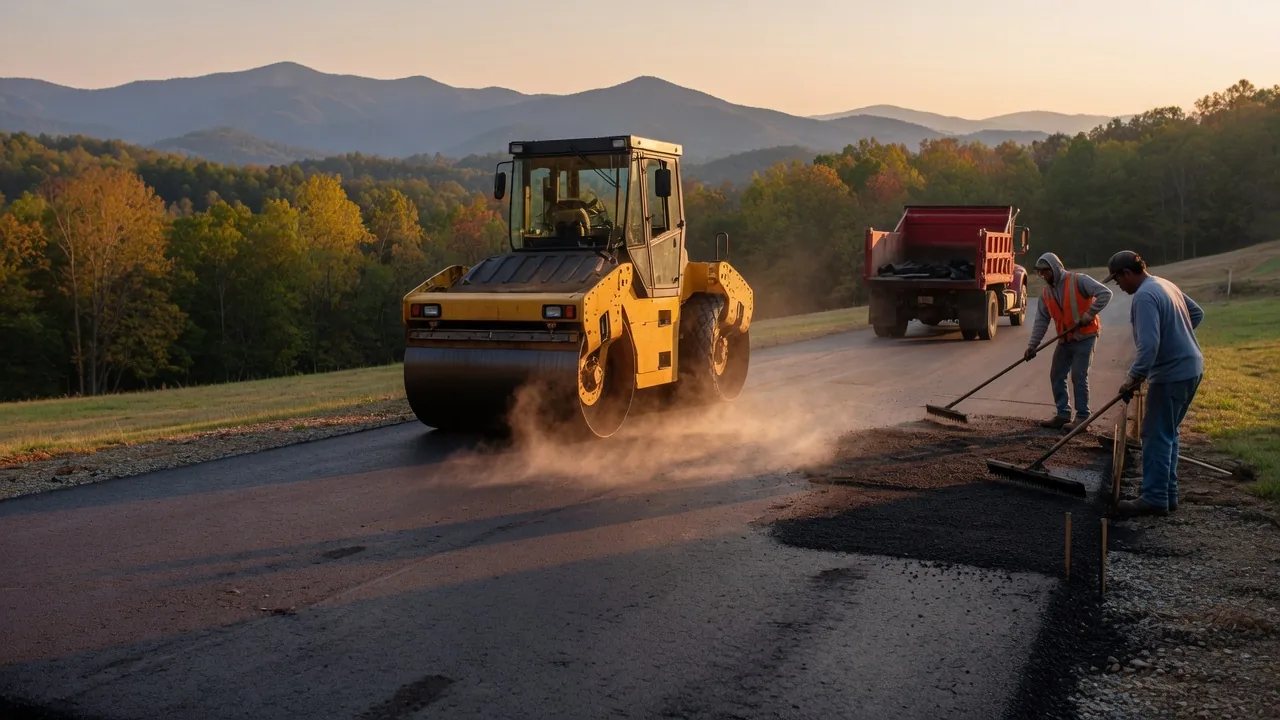
In practice this means two things. First, base depth and compaction have to match the load and grade: four inches of compacted aggregate base is a minimum, and six is standard on any driveway with meaningful slope. Second, chip size in the tar-and-chip surface should be specified for traction, not aesthetics. A coarser stone holds a grade better and drains faster; a fine chip can become slick on a wet slope. Ask your contractor to specify chip size before the job starts — it is a decision worth making explicitly, not a detail left to whoever runs the spreader that day.
Gravel, hot-mix, or tar and chip — reading the upgrade path
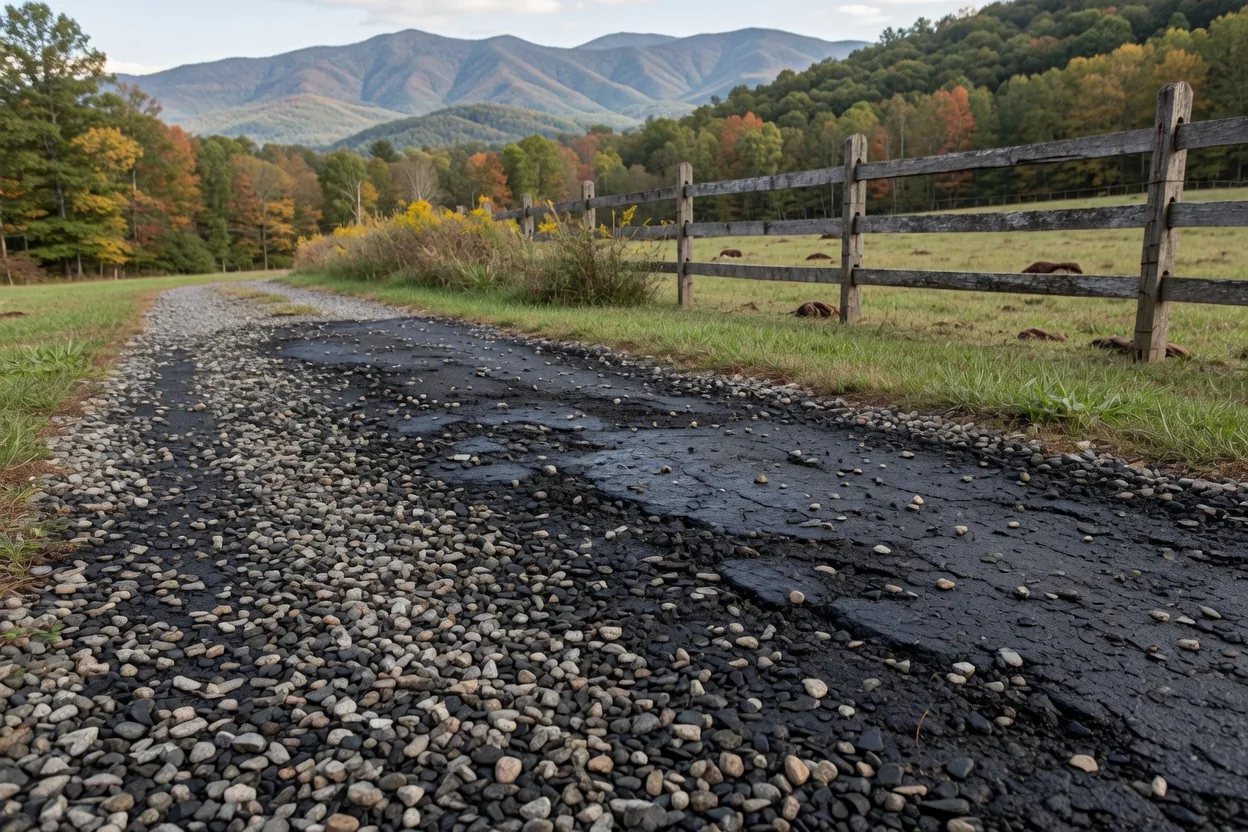
A notable share of Black Mountain driveways are still gravel. Older mountain properties often stayed unpaved because the roads into the lot made bringing in paving equipment difficult enough to defer the project for decades. Access to many of those properties has improved, and the conversion conversation is more common now. If you're starting from gravel and weighing which surface to commit to, the gravel-to-paved conversion guide covers what a gravel base carries forward and what needs to be rebuilt regardless of the final surface choice.
Hot-mix asphalt dominates the region, but it has real weaknesses on mountain driveways — the softening in summer heat, the traction loss when wet, and the way it collects and holds ice differently than a rougher surface. Tar and chip occupies a practical middle position: it costs more than gravel to install, less than a heavy asphalt overlay, handles grade better than blacktop, and reads visually as part of the mountain landscape rather than against it. For residential approaches through a forested setting, that last consideration tends to matter more to homeowners here than it does in an urban subdivision.